“1949: What were my influencers doing?” Republished especially for the friends I’ve made since 2020.

In only six years, this post already reads like a time capsule. It’s sprinkled with tidbits that friends I’ve made since 2020 might be interested in. For this and other reasons, it deserves another airing. I’ve deleted only the closing section that lists posts to be reincarnated in my Christian Individualism: The Maverick Biblical Workmanship of Otis Q. Sellers.—A.G.F.

Last December 15th [i.e., 2029], in Birdland, 1949-1965: Hard Bop Mecca, I marked the 70th anniversary of the opening of that legendary Jazz club on Manhattan’s Broadway off 52nd Street. Over the weekend, I wondered what else was going on that year, but not the trivia one can learn from Wikipedia, such as:

    • President Harry S. Truman’s inauguration in January
    • Astronomer Fred Hoyle’s coining of “big bang” (a term of disparagement) in March
    • Hamlet’s Best Picture Oscar win later that month
    • The opening of Arthur Miller’s Death of a Salesman in February at the Morosco (six blocks south of Birdland’s near-future site)
    • The Soviet Union’s successful A-bomb test in August and Truman’s sharing that news a month later
    • Twin Communist victories: the proclamation of the People’s Republic of China on the first of October and of the German Democratic Republic a week later.

World War Two was in the rearview mirror. but the Cold War with its threat of mutually assured nuclear destruction was straight ahead.

No, I was remembering what writers who influenced me over the past fifty years were doing in 1949. Most of the embedded links below will take you to posts that elaborate upon that influence.

Herbert Aptheker, 1915-2003

In 1949 Communist Herbert Aptheker, a 34-year-old World War II veteran and a Columbia University Ph.D. (and my future comrade, friend, and employer), was compiling material for his A Documentary History of the Negro People in the United States, whose first volume came out in 1951. (The series would grow to seven.) In April, Aptheker received W. E. B. Du Bois’s letter in reply to Aptheker’s request that he testify for the defense at the Foley Square trial of Communist Party leaders. The trial had begun in January; Aptheker himself testified on August 19th.[1]

Anthony Flood, “Herbert Aptheker: Studies in Willful Blindness” (2019). Buy on Amazon.

Du Bois’s letter shows the address from which he sent it: 23 West 26th Street in Manhattan, originally a John Jacob Astor townhouse, built in 1881. In 1924 Astor’s son Vincent “sold the building for $30,000 to Frederick Vanderbilt Field [1905-2000]”—yes, those Vanderbilts—“a Communist who wrote for the Daily Worker published by Political Affairs Publishers, Inc.”[2]

Alphaeus Hunton on his release from prison 1951; Dorothy Hunton; Paul Robeson; W. E. B. Du Bois

The New York State Communist Party expressed interest in buying the building from Field in 1957. This was six years before Du Bois joined the Party. In 1949, however, Du Bois, Paul Robeson, Alphaeus Hunton, and Max Yergen had been meeting there since 1942 as officers of the Council on African Affairs, a Field-funded operation. In 1950 Du Bois ran for U.S. Senate on the American Labor Party ticket (the New York incarnation of the national Progressive Party). Field’s 1983 autobiography, From Left to Right (New York: Lawrence Hill), is a good read.

C. L. R. James (1901-1989)

The month Birdland opened, C. L. R. James slammed Herbert Aptheker’s work in African-American history.[3] But Aptheker the Stalinist wouldn’t give James, the author of The Black Jacobins and Trotskyist scholar, the time of day, let alone answer his criticisms. Aptheker had more in common with James, a fellow Marxist-Leninist, than with Arthur Schlesinger, Jr., whom Aptheker preferred to debate. Schlesinger, historian of American liberalism, sparred with Aptheker at Harvard University about the Cold War and “The Vital Center” (the title of Schlesinger’s just-published book).[4]

Genuine believers in free institutions must be anti-Communists, Arthur M. Schlesinger, Jr. ‘38, associate professor of History, said last night at a John Reed Club debate which overflowed Emerson D.  Opposing Schlesinger in the discussion, entitled “The Center and the Left,” Herbert Aptheker, associate editor of Masses and Mainstream, charged that the “vital center” of which Schlesinger is a proponent, “only maintains what exists, namely monopoly capitalism.” He called for a unity among all non-conservatives “so that a war against Fascism and capitalism can and must be successful.”[5]

Left totalitarians love to smear their opponents as “fascists,” don’t they.

Murray Rothbard (1926-1995). This was taken in 1943.

Murray Rothbard’s first publication, a review of A Mencken Chrestomathy, appeared in Analysis, August 1949.[6] The author, who became my friend when he was 58, was then all of 23. Earlier that year he heard Ludwig von Mises was going to lead a seminar at New York University in the fall. Murray was already a defender of free markets, but not yet a Misesian. Human Action, the expansion and translation of Mises’s Nationalökonomie, was published that October, intellectually converted the young  man.

I was scarcely familiar with Mises’s name, outside of the usual distorted story of the socialist calculation debate, and was therefore surprised to learn in the spring of 1949 that Mises was going to begin a regular seminar at NYU [New York University]. I was also told that Mises was going to publish a magnum opus in the fall. “Oh,” I asked, “what’s the book about?” “About everything,” they replied. Human Action was indeed about everything. The book was a revelation to those of us drenched in modern economics; it solved all problems and inconsistencies that I had sensed in economic theory, and it provided an entirely new and superb structure of correct economic methodology and theory. Furthermore, it provided eager libertarians with a policy of uncompromising laissez-faire; in contrast to all other free market economists of that day or later, there were no escape hatches, no giving the case away with “of course, the government must break up monopolies,” or “of course, the government must provide and regulate the money supply.”[7]

Sidney Hook (1902-1989) and John Dewey (1859-1952), 1949.

In February of 1949 the New York Times published “Should Communists be permitted to teach?” by Aptheker’s nemesis (and future NYU philosophy professor of mine), Sidney Hook, whose writings served as a halfway house for me as I broke with Stalinism in the mid-‘70s. (A few years ago, I applied Hook’s principles in “Is Herbert Aptheker a Historian? Can a communist tell the truth?”), now the fourth chapter of my Herbert Aptheker: Studies in Willful Blindness.)

Anti-Communist demonstrators outside the Waldorf Astoria, March 25, 1949

In March 1949, Hook and other anticommunist academics and cultural figures protested the Communist front operation that the Congress for Cultural Freedom, which met at the Waldorf Astoria in 1949 and 1950, revealed itself to be.[8] That year Hook also penned, among many other articles and reviews, a tribute to his mentor, John Dewey.[9]

Bernard Lonergan (1904-1984). This was taken in the 1940s.
Brand Blanshard (1892-1987). This was taken at Swarthmore College in 1941, two years after The Nature of Thought was published.

In 1949 Bernard Lonergan, S.J., whose magnum opus I used to extricate myself from the rationalism of Brand Blanshard’s The Nature of Thought, began to present to small groups papers that would eventually become Insight, his “essay in aid self-appropriation” published in 1953. That year also saw the publication of the fourth and fifth installments in his series, “The Concept of Verbum in the Writings of St. Thomas Aquinas” in Theological Studies.[10] In 1983, when he was convalescing at the Campion Center (a Jesuit infirmary in Weston, Massachusetts), I spoke with him about Austrian economists. “Well, they’re deductivists. And you know what I think of deductivists.”

Susanne K. Langer (1895-1985). Fortune Magazine, March 1945

Lonergan was impressed with Susanne K. Langer’s Feeling and Form enough to cite it a couple of times in Insight. That’s how I learned of her work, and around 2008 I finally got around to marking up her Philosophy in a New Key: a Study in the Symbolism of Reason Rite and Art. For the first time, the arts were for me not just enjoyable, but also intelligible. First published in 1942, a mass market paperback edition hit the stands in 1949.

What could Langer, a materialist (or naturalist) in all but name, offer Lonergan a Transcendental Thomist? Monsignor Richard M. Liddy, who wrote his dissertation on Langer after studying under Lonergan in Rome, supplied an answer in “What Bernard Lonergan Learned from Susanne K. Langer.”[11]

Eric Voegelin (1901-1985). Early 1930s.

In 1949 Eric Voegelin, another profound influence with whom I had a chance to speak (also in 1983, my annus mirabilis), published a paper on Plato’s Gorgias.[12] The publication of the first volume of his Order and History still lay seven years in the future.

Will Durant (1885-1981), Ariel Durant (1889-1981). This was taken in 1948.

In 1949 Will Durant was struggling to finish the fourth volume of The Story of Civilization. The Age of Faith, a five-year project, was taking six. From its inception, Ariel, Mrs. Durant, had been a partner in this enterprise; her name joined his on the covers of the series beginning with the seventh volume, The Age of Reason Begins.

M. Stanton Evans (1934-2015)

A teenaged Medford Stanton Evans, a future conservative thought leader and author of, among many other writings, the myth-shattering Blacklisted by History: The Untold Story of Senator Joe McCarthy and His Fight against America’s Enemies, realized he was a man of the Right in 1949 after reading George Orwell’s 1984. “It was about communism . . . I said: ‘Well, I’m against communism. What am I for?’” As for becoming a writer, “No, it never crossed my mind. I did not even think in that day and age about becoming a writer of any type. If I’d had my druthers in 1949, I would have played left field for the Brooklyn Dodgers.”


Otis Q. Sellers (1901-1992). This was taken in 1921, the year he attended Moody Bible Institute in Chicago.

Otis Q. Sellers (1901-1992), an early influence, but one from whom I walked away to chase my intellectual lusts and to whom I’ve returned as a prodigal son, was testing his discovery of the premillennial Kingdom of God. He announced this in The Word of Truth, Volumes XI, 1949-1950 under the series entitled “The Order of Things to Come.” He’d develop this idea during the 1950s, but he was ready to present it publicly in that volume’s fifth issue, dated January 1950 and therefore written probably during the last weeks of 1949. Here’s a passage:


Many there are who believe that the next great event of prophecy is the rapture or catching away of all living believers, followed by the resurrection of the dead in Christ, this to be followed by the great tribulation upon the earth, the second coming of Christ, the millennial kingdom, then the new heavens and the new earth. This, in brief, is the position held by most dispensational fundamentalists, a position which we have often designated in these pages as the Darby-Scofield system of prophetic interpretation. However, it is my conviction that this system has failed to recognize those prophecies which reveal an aspect of the kingdom of heavens which precedes the millennial kingdom, and, therefore, precedes the second coming of Christ. This I call the premillennial kingdom of the heavens since it precedes the millennial kingdom.

I continue to appreciate the intellectual delights afforded by the scholars named above, especially those who, like Blanshard, had a literary gift. Compared to the joy of grasping Sellers’s insights into God’s Word, however, and reflecting upon the industry and integrity which he brought to his pursuit of that pearl of great price, those erstwhile pleasures pale. I no longer long for the fleshpots of academia.

Notes

[1] Here’s the letter.  For a discussion of the trial, see Gary Murrell, “The Most Dangerous Communist in the United States”: A Biography of Herbert Aptheker, UMass Press, 2015, 76-77.

[2] “The Astor Offices at Nos. 21 and 23 West 26th Street,” The Daytonian, August 4, 2012.

[3] C. L. R. James [“J. Meyer”], “Herbert Aptheker’s Distortions,” Fourth International, Vol. 10, No. 11, December 1949. But see also C. L. R. James [“J. Meyer”], “Stalinism and Negro History,” Fourth International, Vol. 10, No. 10, November 1949.

[4] As Schlesinger recalled the event: “The ever reliable Herbert Aptheker denounced ‘The Schlesinger Fraud’ in the Communist monthly Masses & Mainstream as a program groomed to the needs of a ruling class seeking war and fascism.’ In 1949 Aptheker and I held a debate. Neither of us persuaded the other of anything.” A Life in the Twentieth Century: Innocent Beginnings, 1917-1950, Houghton Mifflin Harcourt, 2000, 519. The Aptheker article had appeared in the October 1949 issue of Masses & Mainstream and reprinted in a collection of Aptheker’s essays entitled The Era of McCarthyism, New York: Marzani & Munsell, 1955, 115-129.

[5] “Aptheker clashes with Schlesinger,” The Harvard Crimson, December 3, 1949. For discussion, see Murrell, 82-84.

[6] For Rothbard’s appreciation of analysis’s founder Frank Chodorov who gave Murray’s “fledgling work” a platform, see “Frank Chodorov, R. I. P.,” Left & Right: A Journal of Libertarian Thought, 1967; republished here. For Rothbard’s mature celebration of Mencken, see “H.L. Mencken: The Joyous Libertarian,” New Individualist Review, Vol. 2, No. 2, Summer 1962, pp. 15–27; republished here.

[7] Murray N. Rothbard, The Essential von Mises, Auburn, AL: The Ludwig von Mises Institute at Auburn University, 108. The link will take you to an expanded edition of an essay Rothbard wrote in 1973.

[8] Here’s the CIA’s overview: Origins of the Congress for Cultural Freedom, 1949-50. For the impact of this “peace conference” on a cultural giant caught in the political crossfire, see Terry Klefstad, “Shostakovich and the Peace Conference,” Music and Politics, Vol. 6, No. 2, Summer 2012, 1-21; and Phillip Deery, “Shostakovich, the Waldorf Conference and the Cold War,” American Communist History, Vol. 11, No. 2, 2012, 161-180.

[9] Sidney Hook, “John Dewey at Ninety: The Man and His Philosophy,” The New Leader, October 22, 1949, S-3, S-8.

[10] The series was compiled into a book, edited by David B. Burrell, C.S.C.: Verbum: Word and Idea in Aquinas, University of Notre Dame Press, 1967.

[11] Lonergan Workshop, Vol. 11, 1995, 53-90. I posted the text of this article on my older site. It’s a good introduction to both thinkers.

[12] Eric Voegelin, “The Philosophy of Existence: Plato’s Gorgias,” The Review of Politics, Vol. 11, No. 4, October 1949, 477-498.

[13] Video and transcript of “The Theme is Freedom: Religion, Politics, and the American Tradition,” Booknotes (C-SPAN) interview of M. Stanton Evans, February 5, 1995.

[14] “The Premillennial Kin

Ralph Ellison: another denizen of Herbert Aptheker’s memory hole

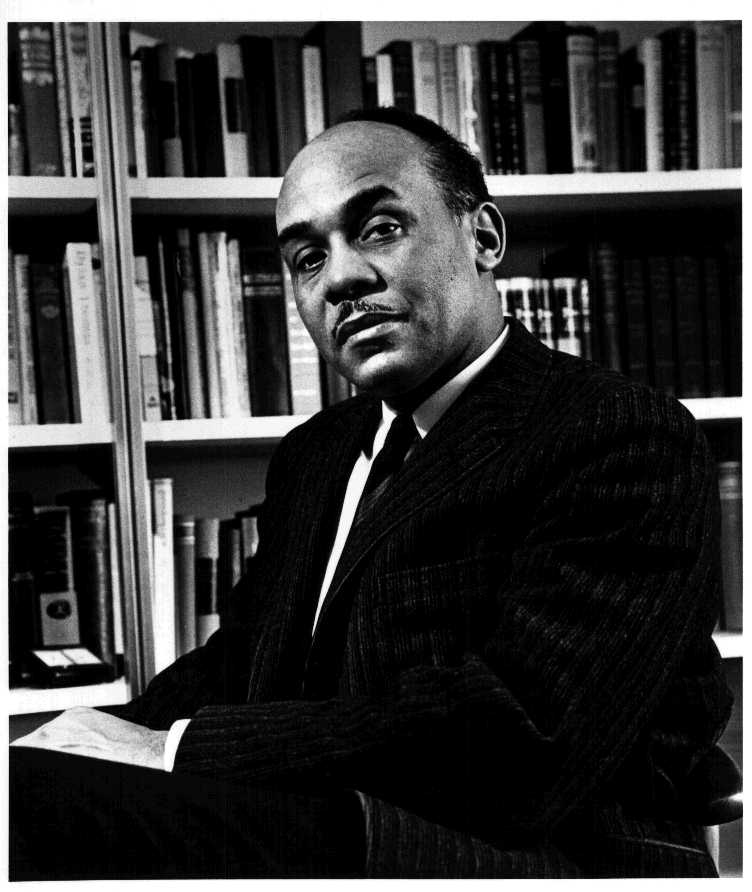
undefinedMy 2013 essay on Herbert Aptheker’s ghosting of C. L. R. James which casts him as the former’s “invisible man” alludes, of course, to the title of Ralph Ellison’s great novel.[1] Today, as I was flipping through Arnold Rampersad’s life of Ellison, Aptheker’s name cropped up, although Ellison’s, like James’s or Richard Wright’s, never did in any of our many chats in his office.  Culturally prominent African Americans whom Aptheker knew, once they were “on the outs” with his party, were to him personae non gratae, regardless of their achievements.

U.S. Army Major Herbert Aptheker (1915-2003) in 1946, his last year of active duty, seventh as member of the Communist Party USA. Earl Conrad, “A Historian Comes Home,” Chicago Defender, March 16, 1946, page 14.

Such were the choices [Rampersad writes] facing Ralph as he found himself fallen among radicals in New York [in the mid-1930s]. He probably became, at least for a while, a dues-paying [Communist] party member. Herbert Aptheker, a scholar and Communist who knew Ralph from these years and believed that he was a fellow member, recalled that “it was really easy to join the Party. You simply signed up. Ralph would not have had to submit to tests or special study or anything like that. He would have been welcomed right away.”[2]

[Ellison] received a note . . . asking him to contribute an essay to a new journal of African-American affairs, to be sponsored by the recently formed Negro Publication Society. The society, tightly linked to the radical left, included the young Communist historian Herbert Aptheker, the black intellectuals Arthur Huff Fauset and Alain Locke, the dramatist Marc Blitzstein, the novelist Theodore Dreiser, the artists Rockwell Kent, and Henrietta Buckmaster . . . . The most celebrated person involved was the proposed editor of the journal, Angelo Herndon . . . .

Now, in 1941, as secretary of the Negro Publication Society, he [Ellison] was the editor of The Negro Quarterly: A Review of Negro Life and History. . . . Ralph would insist later that Herndon published the magazine in defiance of the Party, which presumably saw it as a diversion from its goal of uniting blacks and whites in the war effort. [3]

In March 1942, then Herndon launched the journal . . . he invited Ralph. . . . He liked the look of the first number. Dominated by a long, heavily footnoted article on slavery[4] by Aptheker, it projected an image of seriousness, if not severity. Either at this party or shortly afterward, Ralph agreed to join the staff as managing editor at a salary of $35 a week.[5]

[Ellison] declined to attend a conference called by the leftist Harlem Writers Guild at the New School for Social Research. Partly as a result, he became its prize scapegoat, attacked by writers such as [John Oliver] Killens, John Henrik Clarke, and Herbert Aptheker.[6] 423

In other words, Aptheker gave Ellison the same treatment he gave ex-comrade Wright and for the same reason: there’s no lower form of life than a renegade from the cause of revolution.[7]

Ralph Waldo Ellison (1913-1994) in 1961

Notes

[1] Ralph Ellison, Invisible Man, Random House, 1952. My essay is anthologized in Herbert Aptheker: Studies in Willful Blindness, self-published, 2019.

[2] Arnold Rampersad, Ralph Ellison: A Biography, Knopf, 2008, 93; from Rampersad’s interview of Aptheker, June 25, 2001.

[3] Rampersad, Ellison, 152.

[4] To the inaugural issue of The Negro Quarterly: A Review of Negro Life and History, Spring 1942, Aptheker  contributed “The Negro in the Abolitionist Movement.” That is, it was about African American resistance to slavery. That year, International Publishers published that essay as a booklet; Aptheker anthologized it in his Essays in the History of the American Negro, International Publishers, 1945, 1964. Note that Doxey Wilkerson‘s “Negro Education and the War” is the first article in the first issue.

[5] Rampersad, Ellison, 153.

[6] Rampersad, Ellison, 423.

[7] Anthony Flood, “Did Richard Wright want to ‘kiss the hand of the man who wrote American Negro Slave Revolts”? Yes, according to that hand’s owner. Notes on a mutual suspension of hostilities,’ June 1, 2025.

Herbert Aptheker’s academic ghosting didn’t end with C. L. R. James: the case of Doxey Wilkerson.

Doxey A. Wilkerson, 1905-1993

Apart from Shirley Graham Du Bois (1896-1977), no one knew more about her husband W. E. B. Du Bois (1868-1963) than his literary executor, Herbert Aptheker (1915-2003). Not far behind, if this were a competition, would be Black labor activist, scholar, and fellow Communist theoretician Doxey A. Wilkerson (1905-1993).[1]

From 1948 to 1957, Wilkerson was the Director of Curriculum of the Communist Party-run Jefferson School of Social Science (northwest corner of Sixth Avenue and 16th Street in Manhattan) where Aptheker and Du Bois taught classes. This period saw Du Bois’s marked shift to Marxism-Leninism, culminating in his formally applying for Party membership in 1961.[2]

Since Wilkerson wrote the introduction to Aptheker’s The Negro People in America: A Critique of Gunnar Myrdal’s An American Dilemma (1946) and reviewed it six years later in a party periodical that Aptheker edited, it was odd that Aptheker omitted mention of Comrade Wilkerson’s review when preparing for publication the first critical scholarly edition of Du Bois’s 1952 In Battle for Peace.[3] Philip Luke Sinitiere, an empathetic Du Bois and Aptheker scholar,[4] writes:

. . . the absence of an expansive review of In Battle for Peace published in the October 1952 issue of Masses & Mainstream is a more curious omission [in the 1976 edition], both in Aptheker’s archives and in the Kraus Thomson edition. CPUSA [Communist Party United States of America] member and Black radical Doxey Wilkerson praised In Battle for Peace as a “moving story” of “practical freedom struggles” and a “profoundly perceptive critique of our decadent imperialist society” that Du Bois penned with “masterful prose, wit and scathing satire.”

. . . Unlike other reviewers, however, Wilkerson’s incisive Marxist analysis registered important critiques of the book. First, he held that Du Bois’s use of the term socialism captured all forms of “public ownership” instead of focusing on “collective ownership” with “working class control of the state.” In other words, for Wilkerson’s tastes, Du Bois’s radical discourse lacked theoretical precision and the finer points of communist doctrine over which Party members sparred.[5]

Continue reading “Herbert Aptheker’s academic ghosting didn’t end with C. L. R. James: the case of Doxey Wilkerson.”

Trotskyist power didn’t “degenerate” into slavery, but began with it. The irony of C. L. R. James’s support for compulsory labor.

(The series continues)

The essence of War Communism [1918-1921] was that we actually took from the peasant all his surpluses, and sometimes not only the surpluses, but part of the grain the peasant needed for food. We took this in order to meet the requirements of the army and to sustain the worker.—Vladimir Lenin [1]

Kronstadt sailors, 1921, posing with a flag vowing “Death to the bourgeoisie.”

Every communist intellectual, no matter how humanistically educated, has an ethical Achilles’ Heel. C. L. R. James was no exception. For years, I’ve been fascinated by his story and ideas. (Feel free to search his name on this site.) Every so often, however, I splash my face with cold water to remind myself of the horrors that James shut out of view (when he didn’t rationalize them outright). If I’ve created the impression that I’m starry-eyed over an intellectual’s literary achievement at the expense of flesh-and-blood victims of the policies he owned, then I must counter that impression.

In the mid-1930s, James was an apologist for Lenin and Trotsky’s “War Communism,”[2] i.e., bloody totalitarian dictatorship, including their suppression of the revolutionary sailors at the Kronstadt naval base in March 1921.[3]  That is, the Pan Africanist James sided with a social system as evil as the one that had enslaved Robert Alexander James, his grandfather, in the New World.

After creating the Red Army, Trotsky introduced into factories and fields an army’s characteristic regimentation of labor, thereby helping to install new slave masters to replace Russian serfdom’s. Some socialists noticed. As Paul Avrich, cited in the first note above, wrote:

Menshevik leaders compared the new regimentation to Egyptian slavery, when the Pharaohs used forced labor to build the pyramids. Compulsion, they insisted, would achieve no more success in industry than in agriculture.[4] Continue reading “Trotskyist power didn’t “degenerate” into slavery, but began with it. The irony of C. L. R. James’s support for compulsory labor.”

Did Richard Wright want to “kiss the hand of the man who wrote American Negro Slave Revolts”? Yes, according to that hand’s owner. Notes on a mutual suspension of hostilities.

(Continuing the series)

Richard Wright, Paris, 1947

I was taken aback when I first read those words.[1] I reproduced them in my review of Gary Murrell’s biography of Herbert Aptheker: “A biographer must leave out many things, of course, but one wonders why this meeting had to be one of them.”[2]

Aptheker, didn’t take kindly to apostates from Communism, the God who had failed the famous black novelist.

Herbert Aptheker, stateside, 1945-1946

According to Aptheker, however, they agreed to meet in a Manhattan hotel room (almost certainly Wright’s). In fairness to Murrell, upon reflection, I believe Murrell omitted this story because no one else could corroborate it.[3] We have only Stuckey’s citation of Crowder’s interview referenced in a paper by Stuckey that Murrell otherwise drew upon several times.

Aptheker’s choice of words, however, makes it hard to question his veracity: the verb that would occur to me, were I making the whole thing up, would be “shake,” not “kiss.” But why would Aptheker confabulate such an event? Continue reading “Did Richard Wright want to “kiss the hand of the man who wrote American Negro Slave Revolts”? Yes, according to that hand’s owner. Notes on a mutual suspension of hostilities.”

The seeds of C. L. R. James’s critical awakening: from Chesterton’s “A Short History of England” to Trotsky’s “History of the Russian Revolution”

(Continuing the series.)

C. L. R. James in Trafalgar Square, August 1935, protesting the League of Nations’ arms embargo on both the invader (Italy) and the invaded (Ethiopia) (Getty Images)

When did Cyril Lionel Robert James become CLR? From his middle-class youth in colonial Trinidad, he was an omnivorous reader, starting with his mother’s library, drinking in classics from Shakespeare to Thackeray[1], but also history, while developing an intense interest in cricket, which he played and, more successfully, covered in the papers.

In his engrossing C. L. R. James in Imperial Britain, a scholarly study of six years of his subject’s life (1932–1938) between Tunapuna, Trinidad, and New York City, Christian Høgsbjerg notes James’s  absorption of the age’s empire-friendly historical narrative. But then he found books that upturned such Received Opinion. Høgsbjerg quotes James from an October 1967 interview wherein James recalls what awakened his capacity for and interest in critical history.

I read an enormous amount of history books . . . chiefly the history of England and later, histories of Europe and ancient civilization. I used to teach history, and reading the lot of them, I gained the habit of critical judgment and discrimination . . . . I remember three or four very important history books. These were a history of England by G. K. Chesterton and some histories of the seventeenth century by Hilaire Belloc. These books violently attacked the traditional English history on which I had been brought up, and they gave me a critical conception of historical writing.[2]

So, James, soon to become a revolutionary Marxist, cited Chesterton and Belloc, orthodox Roman Catholics of the post-Vatican I era, as the fons et origo of his critique of bourgeois historiography![3]

In the early 1930s, under the influence of Trotsky’s A History of the Russian Revolution, James began researching the Haitian revolution. (“At the end of reading the book, Spring 1934, I became a Trotskyist  . . .” That is, after his expatriation to the UK, not while in Trinidad. See the October 1967 interview cited in note 2.) Yet as late as August 1933, caught up in the empire’s self-congratulatory celebration of the centennial of the passage of the Slavery Abolition Act,[4] James let these words be published under his name:

Our history begins with it [the Act]. It is the year One of our calendar. Before that we had no history.[5]

He would never make that kind of statement again.

He soon learned, on his own and through the scholarly labors of his former student (and, as future Prime Minister, jailer) Eric Williams (1911-1981), that the slave trade was not abolished because of its iniquity. It was abolished because the planter class had lost economic power. Human conscience just happened to awaken when slavery’s unprofitability became obvious to them.

To be continued.

Notes

[1] “Thackeray, not Marx, bears the heaviest responsibility for me.” C. L. R. James, Beyond a Boundary. Duke University Press, 1993 (1963).

[2] Høgsbjerg, 161, citing Richard Small, “The Training of an Intellectual, the Making of a Marxist,” in C. L. R. James: His Life and Work, ed. Paul Buhle, London: Allison and Busby, 1986, 49-60. This edition’s pagination, which Høgsbjerg used, that of this PDF, wherein Small’s article is on pages 13-18. James was probably referring to Chesterton’s A Short History of England (1917). One cannot know for sure which of Belloc’s books James had in mind, for among them are biographies of Charles I, Charles II, and James II, as well as a life of Cardinal Richelieu. He also wrote The French Revolution (1911), A History of England (1925), and Europe and the Faith (1920), which covers the 17th century’s broader context. Belloc was a splendid stylist.

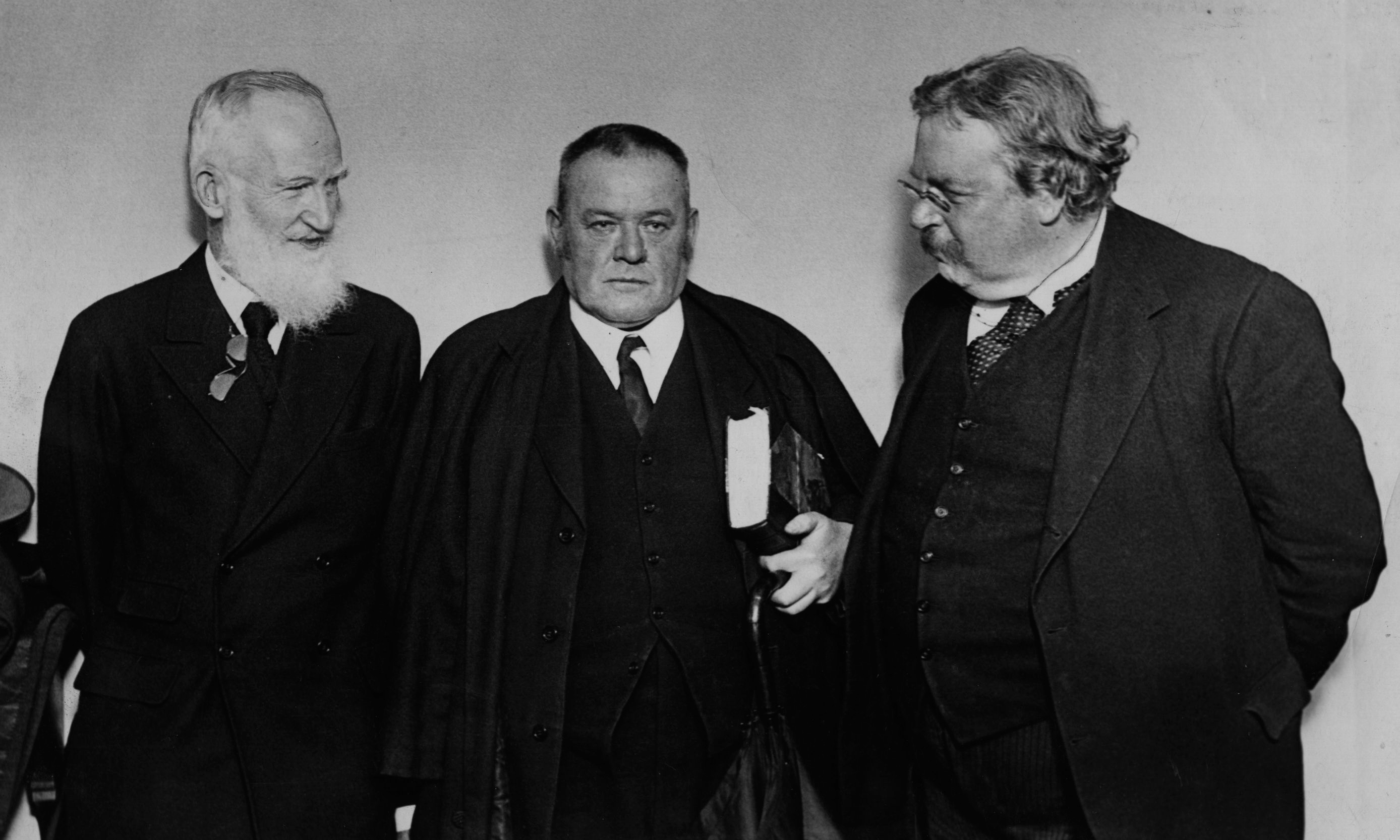
George Bernard Shaw (1856-1950), Hilaire Belloc (1870-1953), Gilbert Keith Chesterton (1874-1936) (1927)

[3] “George Bernard Shaw’s affectionate attack on G.K. Chesterton and Hilaire Belloc, in an article entitled ‘The Chesterbelloc: A Lampoon,’ gave birth to a duomorph destined to find its place in literary legend. Chesterton and Belloc were seen so synonymously, said Shaw, that they formed ‘a very amusing pantomime elephant.’” Joseph Pearce, “The Chesterbelloc: Examining the Beauty of the Beast,” Faith and Reason: The Journal of Christendom College, Spring 2003. Take the link to download the PDF of this article.

[4] What was “abolished,” of course, was Britain’s involvement in the slave trade, on which “good will” the empire traded when they joined Europe’s “scramble for Africa” later in that century.

[5] C.L.R. James, “Slavery Today: Written by the Great-Grandson of a Freed Slave,” Tit-Bits  [London], August 1933, 16. Cited in Høgsbjerg, 169. For zoomable, copyrighted image of that page, go here. Incidentally, “Høgsbjerg,” a Danish surname, is pronounced “Huh-s-BYUR” or “Huh-s-BYAHR.”

The “point” of what, exactly? What “matters”? The groundless ethical imperative of Marxist revolutionaries.

The autograph of the 11th Thesis on Feuerbach: “Philosophen haben bisher nur die Welt anders interpretiert; es kommt aber darauf an, sie zu verändern”

Marx and Engels’s oft-cited 11th Thesis on Feuerbach, penned in 1844 but not published until 1888, is perhaps the closest thing we have to words that function as holy scripture for communists: “Philosophers have only interpreted the world, in various ways; the point, however, is to change it.”[1] Changing the world is allegedly what “matters,” but it’s dogmatically assumed, never argued for. It’s as de fide, as much a matter of faith, as, for example, the Immaculate Conception is for Catholics, and just as ungrounded in Scripture.

The aim of this series is to expose Marxism as an instance of the “foolishness of the wisdom of this world” (1 Corinthians 1:20) from the Bible’s standpoint. No Marxist as such has warrant for pontificating that “the point” is to change the world. The point of what? What can be “the point” in an ultimately pointless world, as distinct from the world in which God works all things according to the counsel of His will (Ephesians 1:11)?

My focal points, as you know by now, are C. L. R. James, Richard Wright, and Herbert Aptheker, men who understandably (only because they lived in God’s world and were created in His image) raged against the indignities of racial subjugation, colonialism, and imperialism that they experienced, witnessed, or studied. (That’s an inclusive “or,” by the way.) For several decades of their lives, they believed that they found in Marxism the conceptual tools they needed for addressing those evils.

Their biographies make for stimulating reading, but how does Marxist revolution answer the moral outrage of interracial subjugation, cruelty, and savagery, especially since we know that it has only added to the history of moral outrage? How can Marxist theory articulate any ethical complaint without borrowing from the Christian worldview they thought was beneath their notice? Continue reading “The “point” of what, exactly? What “matters”? The groundless ethical imperative of Marxist revolutionaries.”

“They will kill you”: Stalinists and the implicit threat of violence. Four retrospections.

This continues the study I began here and here.

This, to me, was a spectacle of glory; and yet, because it had condemned me, because it was blind and ignorant, I felt that it was a spectacle of horror. The blindness of their [Communists’] limited lives—lives truncated and impoverished by the oppression they had suffered long before they had ever heard of Communism—made them think that I was with their enemies. American life had so corrupted their consciousness that they were unable to recognize their friends when they saw them. I knew that if they had held state power, I should have been declared guilty of treason and my execution would have followed.—Richard Wright, 1944[1]

Forty-seven years later, another Stalinist uttered those three words:

Had that leadership [of the Communist Party] held state power, past history suggests that those signers [of “An Initiative to Unite and Renew the Party”] would now be dead.—Herbert Aptheker, 1991[2]

About a year after Wright arrived in New York, an anti-Stalinist revolutionary was also New York-bound from England, but a Stalinist graciously but firmly warned him:

There was a black man who had joined the CP [Communist Party of Great Britain]. He said to me that you could do that in Britain and keep breaking up their meetings, but in America, if you carry on like that, they will kill you. As far as the police were concerned, if a Stalinist killed a Trotskyist, they would have no part of that, so just take it easy. The difference between British democracy and democracy in the United States is that there you have to be aware, not of the government, but of the Stalinists.—C. L. R. James, circa 1938.[3]

In 1978, on the corner of Wall and Broad Streets in Manhattan’s financial district,  where I would listen to Gabe Monheim expound the Scriptures and soon come to Christ, an older Stalinist I had known a few years earlier—his face contorted in hatred and words dripping in bile—volubly branded me a “counterrevolutionary traitor.” I have no doubt that had “tough Tony from Da Bronx” taken the bait, he would have met the fate that James’s Stalinist acquaintance predicted.

Notes

[1] Richard Wright, “I Tried to Be a Communist,” The Atlantic Monthly, September 1944, 54; italics mine. This was the second part of a two-part series that became a chapter of The God That Failed, Richard Crossman, ed., Columbia University Press, 2001; originally, The God That Failed: A Confession, Harper & Brothers, 1949.

[2] Herbert Aptheker, December 14, 1991, cited in Gary Murrell, “The Most Dangerous Communist in the United States”: A Biography of Herbert Aptheker, UMass Press, 2015, 335; italics mine. For an account of that “initiative” and its denouement, see Jaiveer Kohli, “The Last American Communists: The Story of the Fall of the Communist Party USA,” The Journalist as Historian, May 22, 2019.

[3] Interview of C. L. R. James by Al Richardson, Clarence Chrysostom, and Anna Grimshaw in South London, June 8 and November 16, 1986; italics mine.

Three years before that interview, that is, in 1983, James received an honorary degree from Hull University. At the podium is Baron Wilberforce, a great-great-grandson of abolitionist William Wilberforce. For the background, go to https://www.africansinyorkshireproject.com/clr-james.html

Whence “revolutionary” moral outrage? An attempt at a biblical answer.

That’s the question underlying my current project. Answering it might explain why I was drawn to revolutionary Marxism (of interest at least to me, if not to you).  Youngsters can be at once hypercritical and credulous. Revolutionary rejecters of the existing order, they fall for one or another “explanation” hook, line, and sinker.

Rummaging through the lives of Marxist intellectuals is no mere romantic, antiquarian interest of mine (although it is partly that). I will draw upon but not add to the biographies already written. I’m trying to understand, to the extent it is intelligible, the demonic madness we see on college campuses, draped in the language of moral outrage. (“F—  finals! Free Palestine!,” announced one savage disrupting  Columbia University students who were trying to use the main library to prepare for final exams, to cite only one example. I find the categories of intelligibility in Christian theology, specifically anthropology.

Created in God’s image and living in His world as (we all are), the miscreants have a sense of moral outrage (however misinformed), but they have nothing in which to ground it. On Monday, they’ll affirm that it’s wrong to starve children; on Tuesday, that an unborn child’s natural protector has the right to procure the services of an abortionist to destroy that child chemically, or cut him or her to pieces, or leave him or her to expire on a metal table. Most of them, if pressed, will say that, strictly speaking, we don’t know that we have more moral dignity than that of “evolved,” i.e., rearranged, pond scum. They merely dogmatize that we do.

I’m stepping back from the news and noise of the day to reflect on more civilized specimens of humanity, however much their careers betrayed the civilizing impulse. I want to explore why they thought Marxist revolution adequately addressed the moral outrage of interracial subjugation, cruelty, and savagery, evils that energized them? That it was such an answer is the conclusion at which my three very different intellectuals arrived.  It all starts with outrage at one or another fact in one man’s experience: colonialism, imperialism, slavery, peonage, Jim Crow.

I will also ask whether these men, if they were alive today, would embrace today’s savages. I fear they would have, as counterintuitive as such a conclusion might strike some. Continue reading “Whence “revolutionary” moral outrage? An attempt at a biblical answer.”

Richard Wright: Herbert Aptheker’s Other (Almost) Invisible Man

Richard Wright (1908-1960), Lido, Venice, 1950. (Archivio Cameraphoto Epoche/Getty Images)

The subject line is the working title of a projected study of three fascinating writers and their interactions. I will undertake this as an exercise not only in historical exposition but also in Christian apologetics.

That is, as an epistemologically self-conscious Christian individualist living in the dispensation of the grace of God in anticipation of His inauguration of the Manifest Kingdom of God, I will explore the intellectual and personal trajectories of three radical intellectuals—Herbert Aptheker (1915–2003), C. L. R. James (1901–1989), and Richard Wright (1908–1960)—whose materialist epistemologies rendered their political projects not only impossible of realization, but also absurd. Christians can nevertheless learn from them, if only indirectly.

W. E. B. Du Bois (1868-1963) “The problem of the twentieth century is the problem of the color-line.” The Souls of Black Folk (1903)

United by secularism and engagement with black history, they were collectivists philosophically, but individualists in how they lived their lives. But their individualism was not enough to save them. They all failed to discern the true dividing line of their times and ours: not the “color line” that W. E. B. Du Bois (1868-1963) predicted would define the 20th century, but rather the line in the sand drawn by the God-breathed Scriptures (Matthew 4:4).

Their rejection of the latter marks a common, tragic undercurrent. I will examine their shared but divergent paths, focusing on their anti-Christian secularism, Marxist commitments (Stalinism, Trotskyism, non-Communist revolutionary thought), and struggles with racism, ironically and tragically, they could not interpret soundly, let alone condemn, apart from the worldview they rejected. Their second-rate epigones among our contemporaries are no less intellectually bankrupt, but their frank embrace of the horrors to which their plans lead enhances the relevance of this study, which is of more than antiquarian interest.

Continue reading “Richard Wright: Herbert Aptheker’s Other (Almost) Invisible Man”