
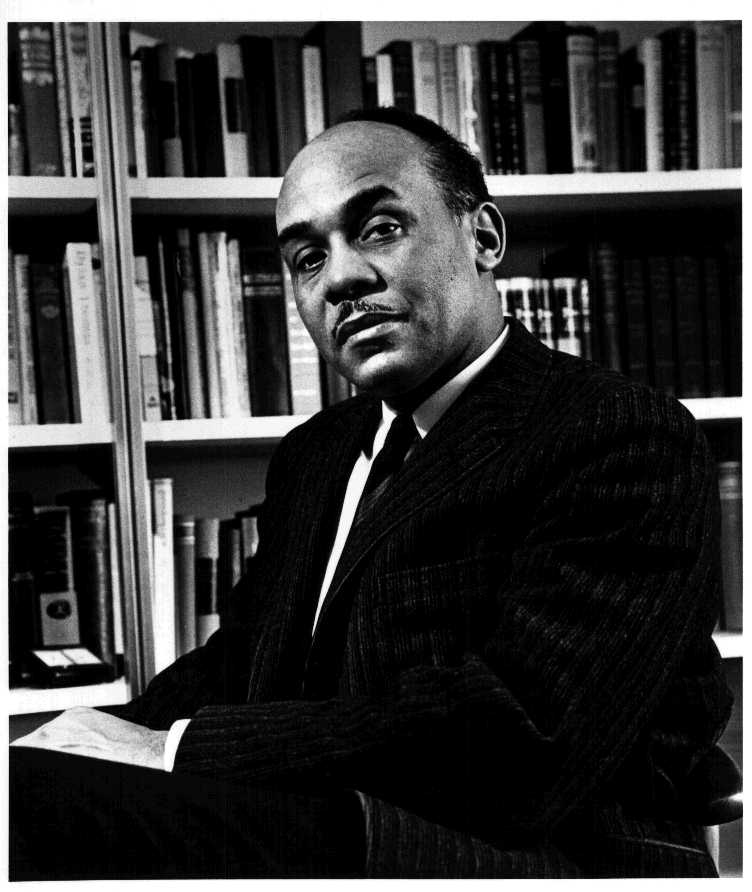
 My 2013 essay on Herbert Aptheker’s ghosting of C. L. R. James which casts him as the former’s “invisible man” alludes, of course, to the title of Ralph Ellison’s great novel.[1] Today, as I was flipping through Arnold Rampersad’s life of Ellison, Aptheker’s name cropped up, although Ellison’s, like James’s or Richard Wright’s, never did in any of our many chats in his office. Culturally prominent African Americans whom Aptheker knew, once they were “on the outs” with his party, were to him personae non gratae, regardless of their achievements.

Such were the choices [Rampersad writes] facing Ralph as he found himself fallen among radicals in New York [in the mid-1930s]. He probably became, at least for a while, a dues-paying [Communist] party member. Herbert Aptheker, a scholar and Communist who knew Ralph from these years and believed that he was a fellow member, recalled that “it was really easy to join the Party. You simply signed up. Ralph would not have had to submit to tests or special study or anything like that. He would have been welcomed right away.”[2]
[Ellison] received a note . . . asking him to contribute an essay to a new journal of African-American affairs, to be sponsored by the recently formed Negro Publication Society. The society, tightly linked to the radical left, included the young Communist historian Herbert Aptheker, the black intellectuals Arthur Huff Fauset and Alain Locke, the dramatist Marc Blitzstein, the novelist Theodore Dreiser, the artists Rockwell Kent, and Henrietta Buckmaster . . . . The most celebrated person involved was the proposed editor of the journal, Angelo Herndon . . . . 
Now, in 1941, as secretary of the Negro Publication Society, he [Ellison] was the editor of The Negro Quarterly: A Review of Negro Life and History. . . . Ralph would insist later that Herndon published the magazine in defiance of the Party, which presumably saw it as a diversion from its goal of uniting blacks and whites in the war effort. [3]
In March 1942, then Herndon launched the journal . . . he invited Ralph. . . . He liked the look of the first number. Dominated by a long, heavily footnoted article on slavery[4] by Aptheker, it projected an image of seriousness, if not severity. Either at this party or shortly afterward, Ralph agreed to join the staff as managing editor at a salary of $35 a week.[5]
[Ellison] declined to attend a conference called by the leftist Harlem Writers Guild at the New School for Social Research. Partly as a result, he became its prize scapegoat, attacked by writers such as [John Oliver] Killens, John Henrik Clarke, and Herbert Aptheker.[6] 423
In other words, Aptheker gave Ellison the same treatment he gave ex-comrade Wright and for the same reason: there’s no lower form of life than a renegade from the cause of revolution.[7]
Notes
[1] Ralph Ellison, Invisible Man, Random House, 1952. My essay is anthologized in Herbert Aptheker: Studies in Willful Blindness, self-published, 2019.
[2] Arnold Rampersad, Ralph Ellison: A Biography, Knopf, 2008, 93; from Rampersad’s interview of Aptheker, June 25, 2001.
[3] Rampersad, Ellison, 152.
[4] To the inaugural issue of The Negro Quarterly: A Review of Negro Life and History, Spring 1942, Aptheker  contributed “The Negro in the Abolitionist Movement.” That is, it was about African American resistance to slavery. That year, International Publishers published that essay as a booklet; Aptheker anthologized it in his Essays in the History of the American Negro, International Publishers, 1945, 1964. Note that Doxey Wilkerson‘s “Negro Education and the War” is the first article in the first issue.
[5] Rampersad, Ellison, 153.
[6] Rampersad, Ellison, 423.
[7] Anthony Flood, “Did Richard Wright want to ‘kiss the hand of the man who wrote American Negro Slave Revolts”? Yes, according to that hand’s owner. Notes on a mutual suspension of hostilities,’ June 1, 2025.