On the 110th anniversary of Herbert Aptheker’s birth

Herbert Aptheker, 57, W. E. B. Du Bois’s literary executor, signing over Du Bois papers to the University of Massachusetts, May 27, 1973. To Aptheker’s right is Du Bois’s widow, Shirley Graham Du Bois.

One hundred ten years ago today, the temperature in Brooklyn was as high as it was yesterday, that is, 93°F, an especially stressful, even dangerous, circumstance for a woman great with child. Yet that day, July 31, 1915, Rebecca Aptheker successfully birthed Herbert, her and husband Benjamin’s fifth and last child, the future scholar of African American history and apologist for communism of the Stalinist kind—and, for a few years in the early 1970s, my friend, comrade, and employer.

The year of Herbert’s nativity also saw the screening of the pro-Ku Klux Klan film, D. W. Griffith’s The Birth of a Nation, in Woodrow Wilson’s White House; the founding of the Association for the Study of Negro Life and Culture by Carter G. Woodson (the only Harvard Ph.D. whose parents had been slaves; in 1946 he replied to a letter Aptheker had written to him); and the passing of Booker T. Washington.

Aptheker’s papers (1842-2005, bulk 1934-1994) are stored and catalogued in the Manuscripts Division of Stanford University. The linked page’s biographical paragraphs, here reproduced and copyedited, provide a compact introduction to aspects of his life. Its bibliographical section is unfortunately incomplete, and the items that are listed are not chronologically ordered. By welcome contrast, that section in his Wikipedia article is both nearly complete and arranged chronologically; there is no need to reproduce it here. Those interested should visit that page and scroll down to “Works.”

Dr. Herbert Aptheker, historian and lecturer, was born in Brooklyn, New York, on July 31, 1915, to Benjamin and Rebecca (Komar) Aptheker. He married Fay Aptheker on Sept. 4, 1942; they had one daughter, Bettina Aptheker, an author and historian in her own right. Aptheker received his B.S. in 1936, an A.M. in 1937, and his Ph.D. in 1943, all from Columbia University. He also holds a Ph.D. (honorary) from Martin Luther University, Halle, Germany, 1966, and a DHL (honorary) from the University of Massachusetts, 1996.

He edited Masses and Mainstream from 1948 through 1952 and Political Affairs from 1952 through 1963. He was the director of the American Institute for Marxist Studies in New York City from 1964 to 1985 and a professor at Hostos Community College, CUNY, from 1971 to 1977. He lectured extensively throughout the United States and Europe since 1941.

He was a visiting lecturer in the Department of History at Bryn Mawr College, 1969-1971; visiting lecturer, University of Massachusetts from 1971-1972; Yale University, 1976; University of California at Berkeley Law School, 1978-1991; University of Santa Clara, 1982-1983; visiting professor, Afro-American Studies, University of California at Berkeley, 1984.

Aptheker ran for the U.S. Congress in 1966 as the Independent Peace candidate and for the U.S. Senate in 1976 as the Communist Party candidate. He served as Major in the Field Artillery of the Army of the United States, European Theater of Operations, 1942-1946.

He served as a Guggenheim Fellow from 1946 to 1947 and received grants from the Social Science Research Council, 1961, the Rabinowitz Foundation, 1965, and the American Council of Learned Studies, 1974. He holds memberships in the American Historical Association and the Association for the Study of Negro Life, which awarded him its History Award in 1939 and 1969. [End]

The Wikipedia entry on Herbert Aptheker is worth consulting, but only as a preliminary to reading Gary Murrell’s The Most Dangerous Communist in the United States”: A Biography of Herbert Aptheker (UMass Press, August 2015), published exactly a century after Aptheker’s birth. I reviewed it in 2016 for American Communist History; a PDF of the review is freely available here, but also republished with other essays in my 2019 Herbert Aptheker: Studies in Willful Blindness.

Search <Herbert Aptheker> on this site for many posts on this historically interesting figure.

Ralph Ellison: another denizen of Herbert Aptheker’s memory hole

undefinedMy 2013 essay on Herbert Aptheker’s ghosting of C. L. R. James which casts him as the former’s “invisible man” alludes, of course, to the title of Ralph Ellison’s great novel.[1] Today, as I was flipping through Arnold Rampersad’s life of Ellison, Aptheker’s name cropped up, although Ellison’s, like James’s or Richard Wright’s, never did in any of our many chats in his office.  Culturally prominent African Americans whom Aptheker knew, once they were “on the outs” with his party, were to him personae non gratae, regardless of their achievements.

U.S. Army Major Herbert Aptheker (1915-2003) in 1946, his last year of active duty, seventh as member of the Communist Party USA. Earl Conrad, “A Historian Comes Home,” Chicago Defender, March 16, 1946, page 14.

Such were the choices [Rampersad writes] facing Ralph as he found himself fallen among radicals in New York [in the mid-1930s]. He probably became, at least for a while, a dues-paying [Communist] party member. Herbert Aptheker, a scholar and Communist who knew Ralph from these years and believed that he was a fellow member, recalled that “it was really easy to join the Party. You simply signed up. Ralph would not have had to submit to tests or special study or anything like that. He would have been welcomed right away.”[2]

[Ellison] received a note . . . asking him to contribute an essay to a new journal of African-American affairs, to be sponsored by the recently formed Negro Publication Society. The society, tightly linked to the radical left, included the young Communist historian Herbert Aptheker, the black intellectuals Arthur Huff Fauset and Alain Locke, the dramatist Marc Blitzstein, the novelist Theodore Dreiser, the artists Rockwell Kent, and Henrietta Buckmaster . . . . The most celebrated person involved was the proposed editor of the journal, Angelo Herndon . . . .

Now, in 1941, as secretary of the Negro Publication Society, he [Ellison] was the editor of The Negro Quarterly: A Review of Negro Life and History. . . . Ralph would insist later that Herndon published the magazine in defiance of the Party, which presumably saw it as a diversion from its goal of uniting blacks and whites in the war effort. [3]

In March 1942, then Herndon launched the journal . . . he invited Ralph. . . . He liked the look of the first number. Dominated by a long, heavily footnoted article on slavery[4] by Aptheker, it projected an image of seriousness, if not severity. Either at this party or shortly afterward, Ralph agreed to join the staff as managing editor at a salary of $35 a week.[5]

[Ellison] declined to attend a conference called by the leftist Harlem Writers Guild at the New School for Social Research. Partly as a result, he became its prize scapegoat, attacked by writers such as [John Oliver] Killens, John Henrik Clarke, and Herbert Aptheker.[6] 423

In other words, Aptheker gave Ellison the same treatment he gave ex-comrade Wright and for the same reason: there’s no lower form of life than a renegade from the cause of revolution.[7]

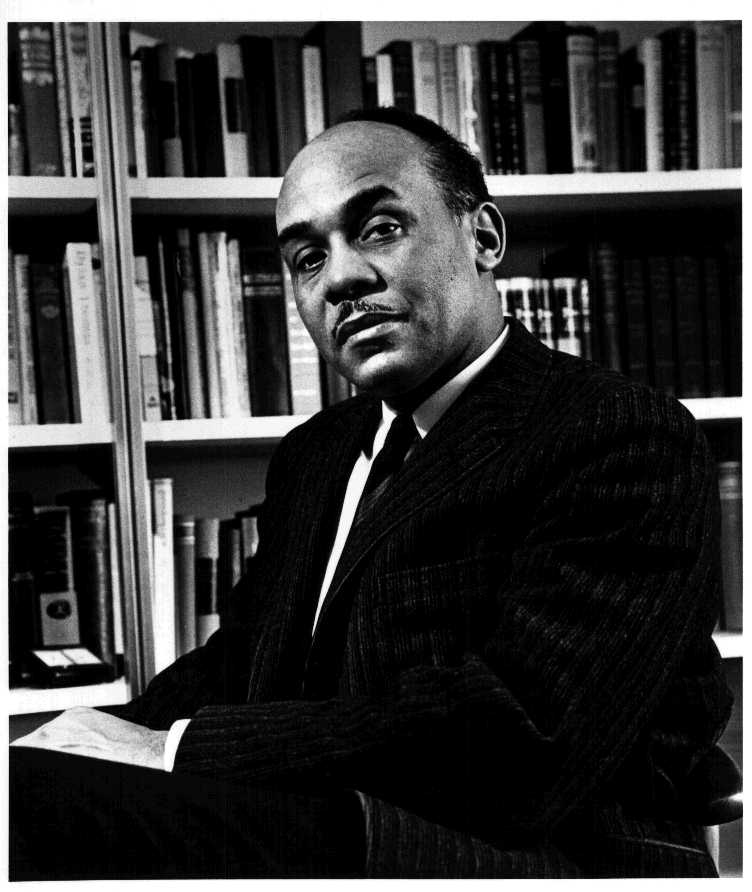
Ralph Waldo Ellison (1913-1994) in 1961

Notes

[1] Ralph Ellison, Invisible Man, Random House, 1952. My essay is anthologized in Herbert Aptheker: Studies in Willful Blindness, self-published, 2019.

[2] Arnold Rampersad, Ralph Ellison: A Biography, Knopf, 2008, 93; from Rampersad’s interview of Aptheker, June 25, 2001.

[3] Rampersad, Ellison, 152.

[4] To the inaugural issue of The Negro Quarterly: A Review of Negro Life and History, Spring 1942, Aptheker  contributed “The Negro in the Abolitionist Movement.” That is, it was about African American resistance to slavery. That year, International Publishers published that essay as a booklet; Aptheker anthologized it in his Essays in the History of the American Negro, International Publishers, 1945, 1964. Note that Doxey Wilkerson‘s “Negro Education and the War” is the first article in the first issue.

[5] Rampersad, Ellison, 153.

[6] Rampersad, Ellison, 423.

[7] Anthony Flood, “Did Richard Wright want to ‘kiss the hand of the man who wrote American Negro Slave Revolts”? Yes, according to that hand’s owner. Notes on a mutual suspension of hostilities,’ June 1, 2025.

Making the aesthetic realm a little less mysterious (to me): what I got from Susanne Langer (1895-1985)

Susanne Katherina Knauth Langer, 1895-1985

During my freshman year at New York University in 1971, I had as my first professor of philosophy Bob Gurland (b. 1933), voted many times Teacher of the Year (by many of his 25 thousand students). One fascinating thing I had learned about him was that he played trumpet in several big bands in the Fifties. (Charlie Barnet’s was one, as I recall.) One day after class, I chatted with him on Waverly Place, half a block east of Washington Square North, about jazz music, which we both love, and I remember interjecting, “That’s not something I want to theorize about.” Neither did he. He added a few words that underscored his head-nodding agreement.[1] I went about my philosophical education knowing both that there was such a thing as aesthetics and that I wasn’t much interested in it.

But as that lack of interest didn’t sit well with me, I was delighted when my reading led me to Susanne K. Langer, who lifted the veil a bit for me. On this site five years ago, I shared my discovery of her writings, which came into my world by way of my long and deep interest in Bernard Lonergan (1904-1984).

Lonergan [I wrote] was impressed with Susanne K. Langer’s Feeling and Form enough to cite it a couple of times in InsightThat’s how I learned of her work, and around 2008 I finally got around to marking up her Philosophy in a New Key: a Study in the Symbolism of Reason Rite and Art. For the first time, the arts were for me not just enjoyable, but also intelligibleFirst published in 1942, a mass market paperback edition hit the stands in 1949.

What could Langer, a materialist (or naturalist) in all but name, offer Lonergan a Transcendental Thomist? Monsignor Richard M. Liddy, who wrote his dissertation on Langer after studying under Lonergan in Rome, supplied an answer in “What Bernard Lonergan Learned from Susanne K. Langer.”[2]

Now, just how did she make intelligible to my prosaic mind the arts that express, enrich, and delight us as souls, that is, as beings capable of enjoyment and suffering?[3] Well, she had an insight into the different “primary illusions” that inform the “great orders of art.” These illusions are “semblances of experienced events,” with music (where she, a trained cellist, started) creating the illusion of time; painting, space; ballet, forces; literature, a virtual past; drama, a virtual present. The primary illusion of film, I reread the other day, is the dream.

I cannot compress her insights into a blogpost without doing violence to their nuance—I know . . . too late—but several key essays (which Langer scholars have told me they’ve found useful in this form) may be read on my old site. But let me give you a taste of how she understands the unity of the diversity of arts. Continue reading “Making the aesthetic realm a little less mysterious (to me): what I got from Susanne Langer (1895-1985)”

The good of order, currently under increasingly violent attack, explained.

In light of the cold civil war that is slowly but surely hotting up, I thought it apt to excerpt the following theoretical (thus the “natural law” lingo) passages from Chapter 20 of Christ, Capital and Liberty: A Polemic, “What Is ‘The Free Market’?”

* * *

By “real” we mean the logical contrast of the illusory, the delusional, the fictional, the artificial, etc. When we know or suspect that we are in the presence of the latter, we appeal to some notion of the real to negotiate our encounter with it. A good analogy is found in the contrast between the true and the false: the notion of truth emerges only through the experience of falsehood. (If we could never experience being in error, or being deceived or lied to, we’d have no use for a notion of truth.)

Whatever is a function of real entities is also real. A market is a network of exchanges that persons, according to their human nature, spontaneously form. (That is, they do not engage in exchange because they read in some book that that’s what they must do.) Markets are functions of persons, and persons are real. (Persons are entities with causal efficacy, however, markets are not.)

The market is an order—specifically, a network of exchanges—that persons naturally create in pursuit of their flourishing (which exceeds in value their mere biological sustenance and continuance).

Since persons generate that order by acting in accordance with their nature, it is a natural order, one level, aspect, or dimension of several that make up the universal natural order. Violations of that order, which tend toward human self-destruction, is not to be put on the same ontological level as that which contributes to human flourishing. Continue reading “The good of order, currently under increasingly violent attack, explained.”

Herbert Aptheker’s academic ghosting didn’t end with C. L. R. James: the case of Doxey Wilkerson.

Doxey A. Wilkerson, 1905-1993

Apart from Shirley Graham Du Bois (1896-1977), no one knew more about her husband W. E. B. Du Bois (1868-1963) than his literary executor, Herbert Aptheker (1915-2003). Not far behind, if this were a competition, would be Black labor activist, scholar, and fellow Communist theoretician Doxey A. Wilkerson (1905-1993).[1]

From 1948 to 1957, Wilkerson was the Director of Curriculum of the Communist Party-run Jefferson School of Social Science (northwest corner of Sixth Avenue and 16th Street in Manhattan) where Aptheker and Du Bois taught classes. This period saw Du Bois’s marked shift to Marxism-Leninism, culminating in his formally applying for Party membership in 1961.[2]

Since Wilkerson wrote the introduction to Aptheker’s The Negro People in America: A Critique of Gunnar Myrdal’s An American Dilemma (1946) and reviewed it six years later in a party periodical that Aptheker edited, it was odd that Aptheker omitted mention of Comrade Wilkerson’s review when preparing for publication the first critical scholarly edition of Du Bois’s 1952 In Battle for Peace.[3] Philip Luke Sinitiere, an empathetic Du Bois and Aptheker scholar,[4] writes:

. . . the absence of an expansive review of In Battle for Peace published in the October 1952 issue of Masses & Mainstream is a more curious omission [in the 1976 edition], both in Aptheker’s archives and in the Kraus Thomson edition. CPUSA [Communist Party United States of America] member and Black radical Doxey Wilkerson praised In Battle for Peace as a “moving story” of “practical freedom struggles” and a “profoundly perceptive critique of our decadent imperialist society” that Du Bois penned with “masterful prose, wit and scathing satire.”

. . . Unlike other reviewers, however, Wilkerson’s incisive Marxist analysis registered important critiques of the book. First, he held that Du Bois’s use of the term socialism captured all forms of “public ownership” instead of focusing on “collective ownership” with “working class control of the state.” In other words, for Wilkerson’s tastes, Du Bois’s radical discourse lacked theoretical precision and the finer points of communist doctrine over which Party members sparred.[5]

Continue reading “Herbert Aptheker’s academic ghosting didn’t end with C. L. R. James: the case of Doxey Wilkerson.”

“Affordability”: Communism’s latest economically illiterate lure

Zohran Mamdani speaks during the 'Zohran For NYC Election Night Party' in New York City, USA.
Marxist Muslim Zohran Mamdani, candidate for New York Mayor running as a Democrat, June 25, 2025

At what rate should scarce resources—in land, labor, or capital—exchange? In plainer English, how much “should” I be paid for the services I render, and how little “should” I have to pay for the things I need? The answer will expose the economic astuteness, or ignorance, of the respondent. If the answer is a function of the pseudo-concept of “affordability,” about which the Democrats, especially their frankly communist faction, cannot stop yapping, then we know it’s ignorance when not also wrapped in mendacity.

June 24, 2025: Guests attending the wedding of Amazon founder Jeff Bezos and Lauren Sánchez observed Amazon’s packaging standards by placing each gift in a box at least four sizes larger than the item.

Maybe Joe Blow can’t spend even a hundred bucks on his wedding, while another JB, Jeff Bezos, can afford to spend $50 million on his. But how did Bezos amass such purchasing power, and whence the ingredients of everything he ever bought and consumed either for business or pleasure? The answer: privately owned scarce goods traded on more or less free markets.

Without respect for property rights in the aforementioned resources, there’s no way to calculate how much of any good or service (and therefore all of them) should be produced and offered for sale. (Keep in mind that we implicitly impute the value of consumption goods back to the ingredients of their production. For example, we value rare earth minerals not because we consume them directly, but because they’re essential ingredients of the goods we do consume.)

Therefore, if you’re an enemy of said rights, then you invite chaos into every economic calculation, yours and mine, Bezos’s and Blow’s, chaos that will inexorably degenerate into a living hell. For that is how shortages and gluts, two cold analytical terms, cash out experientially. And that makes you my enemy: you’re not someone I debate, but someone against whom I arm myself should the state’s monopolized police, courts, and armed forces break down and no free-market alternatives to such socially necessary services are available. Continue reading ““Affordability”: Communism’s latest economically illiterate lure”

Trotskyist power didn’t “degenerate” into slavery, but began with it. The irony of C. L. R. James’s support for compulsory labor.

(The series continues)

The essence of War Communism [1918-1921] was that we actually took from the peasant all his surpluses, and sometimes not only the surpluses, but part of the grain the peasant needed for food. We took this in order to meet the requirements of the army and to sustain the worker.—Vladimir Lenin [1]

Kronstadt sailors, 1921, posing with a flag vowing “Death to the bourgeoisie.”

Every communist intellectual, no matter how humanistically educated, has an ethical Achilles’ Heel. C. L. R. James was no exception. For years, I’ve been fascinated by his story and ideas. (Feel free to search his name on this site.) Every so often, however, I splash my face with cold water to remind myself of the horrors that James shut out of view (when he didn’t rationalize them outright). If I’ve created the impression that I’m starry-eyed over an intellectual’s literary achievement at the expense of flesh-and-blood victims of the policies he owned, then I must counter that impression.

In the mid-1930s, James was an apologist for Lenin and Trotsky’s “War Communism,”[2] i.e., bloody totalitarian dictatorship, including their suppression of the revolutionary sailors at the Kronstadt naval base in March 1921.[3]  That is, the Pan Africanist James sided with a social system as evil as the one that had enslaved Robert Alexander James, his grandfather, in the New World.

After creating the Red Army, Trotsky introduced into factories and fields an army’s characteristic regimentation of labor, thereby helping to install new slave masters to replace Russian serfdom’s. Some socialists noticed. As Paul Avrich, cited in the first note above, wrote:

Menshevik leaders compared the new regimentation to Egyptian slavery, when the Pharaohs used forced labor to build the pyramids. Compulsion, they insisted, would achieve no more success in industry than in agriculture.[4] Continue reading “Trotskyist power didn’t “degenerate” into slavery, but began with it. The irony of C. L. R. James’s support for compulsory labor.”

Did Richard Wright want to “kiss the hand of the man who wrote American Negro Slave Revolts”? Yes, according to that hand’s owner. Notes on a mutual suspension of hostilities.

(Continuing the series)

Richard Wright, Paris, 1947

I was taken aback when I first read those words.[1] I reproduced them in my review of Gary Murrell’s biography of Herbert Aptheker: “A biographer must leave out many things, of course, but one wonders why this meeting had to be one of them.”[2]

Aptheker, didn’t take kindly to apostates from Communism, the God who had failed the famous black novelist.

Herbert Aptheker, stateside, 1945-1946

According to Aptheker, however, they agreed to meet in a Manhattan hotel room (almost certainly Wright’s). In fairness to Murrell, upon reflection, I believe Murrell omitted this story because no one else could corroborate it.[3] We have only Stuckey’s citation of Crowder’s interview referenced in a paper by Stuckey that Murrell otherwise drew upon several times.

Aptheker’s choice of words, however, makes it hard to question his veracity: the verb that would occur to me, were I making the whole thing up, would be “shake,” not “kiss.” But why would Aptheker confabulate such an event? Continue reading “Did Richard Wright want to “kiss the hand of the man who wrote American Negro Slave Revolts”? Yes, according to that hand’s owner. Notes on a mutual suspension of hostilities.”

The seeds of C. L. R. James’s critical awakening: from Chesterton’s “A Short History of England” to Trotsky’s “History of the Russian Revolution”

(Continuing the series.)

C. L. R. James in Trafalgar Square, August 1935, protesting the League of Nations’ arms embargo on both the invader (Italy) and the invaded (Ethiopia) (Getty Images)

When did Cyril Lionel Robert James become CLR? From his middle-class youth in colonial Trinidad, he was an omnivorous reader, starting with his mother’s library, drinking in classics from Shakespeare to Thackeray[1], but also history, while developing an intense interest in cricket, which he played and, more successfully, covered in the papers.

In his engrossing C. L. R. James in Imperial Britain, a scholarly study of six years of his subject’s life (1932–1938) between Tunapuna, Trinidad, and New York City, Christian Høgsbjerg notes James’s  absorption of the age’s empire-friendly historical narrative. But then he found books that upturned such Received Opinion. Høgsbjerg quotes James from an October 1967 interview wherein James recalls what awakened his capacity for and interest in critical history.

I read an enormous amount of history books . . . chiefly the history of England and later, histories of Europe and ancient civilization. I used to teach history, and reading the lot of them, I gained the habit of critical judgment and discrimination . . . . I remember three or four very important history books. These were a history of England by G. K. Chesterton and some histories of the seventeenth century by Hilaire Belloc. These books violently attacked the traditional English history on which I had been brought up, and they gave me a critical conception of historical writing.[2]

So, James, soon to become a revolutionary Marxist, cited Chesterton and Belloc, orthodox Roman Catholics of the post-Vatican I era, as the fons et origo of his critique of bourgeois historiography![3]

In the early 1930s, under the influence of Trotsky’s A History of the Russian Revolution, James began researching the Haitian revolution. (“At the end of reading the book, Spring 1934, I became a Trotskyist  . . .” That is, after his expatriation to the UK, not while in Trinidad. See the October 1967 interview cited in note 2.) Yet as late as August 1933, caught up in the empire’s self-congratulatory celebration of the centennial of the passage of the Slavery Abolition Act,[4] James let these words be published under his name:

Our history begins with it [the Act]. It is the year One of our calendar. Before that we had no history.[5]

He would never make that kind of statement again.

He soon learned, on his own and through the scholarly labors of his former student (and, as future Prime Minister, jailer) Eric Williams (1911-1981), that the slave trade was not abolished because of its iniquity. It was abolished because the planter class had lost economic power. Human conscience just happened to awaken when slavery’s unprofitability became obvious to them.

To be continued.

Notes

[1] “Thackeray, not Marx, bears the heaviest responsibility for me.” C. L. R. James, Beyond a Boundary. Duke University Press, 1993 (1963).

[2] Høgsbjerg, 161, citing Richard Small, “The Training of an Intellectual, the Making of a Marxist,” in C. L. R. James: His Life and Work, ed. Paul Buhle, London: Allison and Busby, 1986, 49-60. This edition’s pagination, which Høgsbjerg used, that of this PDF, wherein Small’s article is on pages 13-18. James was probably referring to Chesterton’s A Short History of England (1917). One cannot know for sure which of Belloc’s books James had in mind, for among them are biographies of Charles I, Charles II, and James II, as well as a life of Cardinal Richelieu. He also wrote The French Revolution (1911), A History of England (1925), and Europe and the Faith (1920), which covers the 17th century’s broader context. Belloc was a splendid stylist.

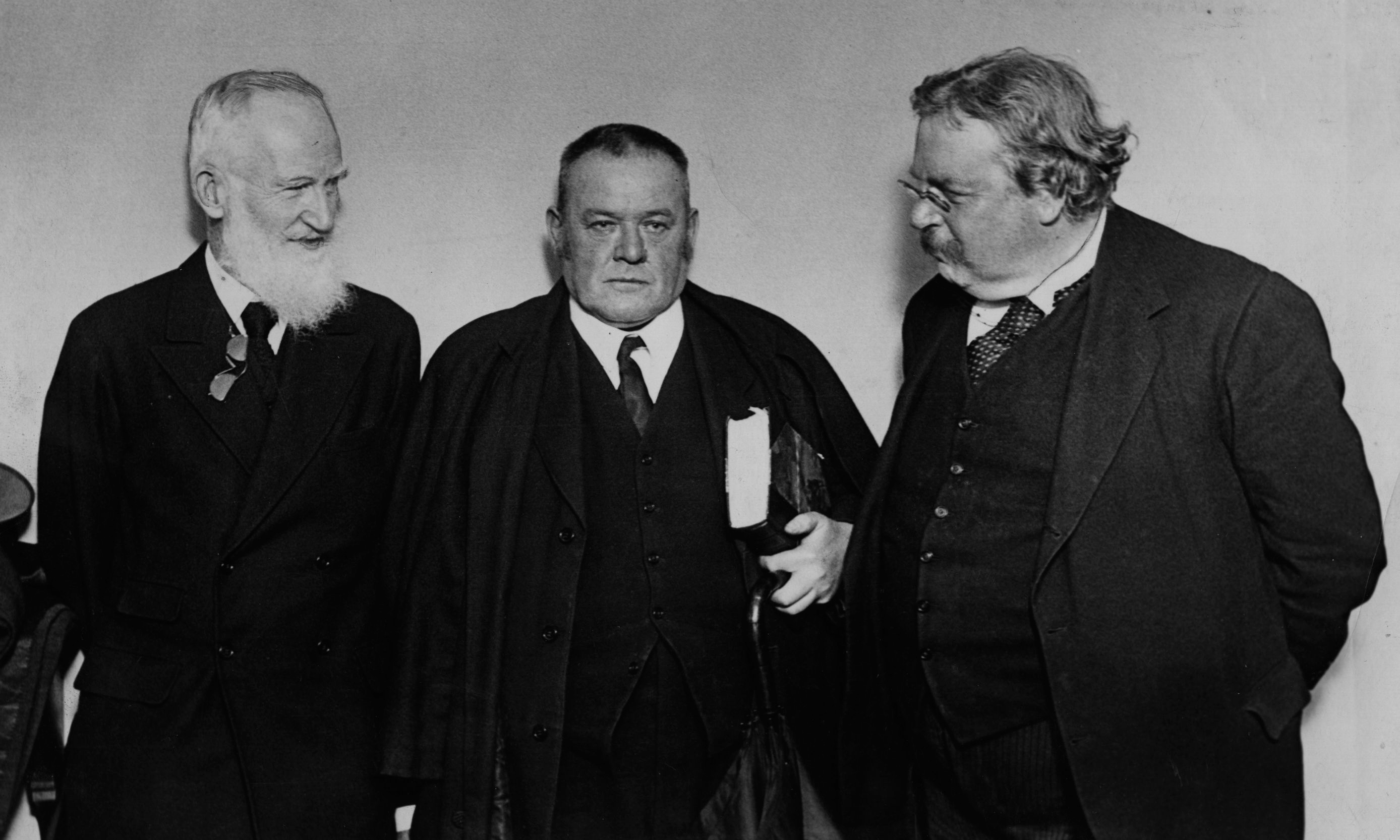
George Bernard Shaw (1856-1950), Hilaire Belloc (1870-1953), Gilbert Keith Chesterton (1874-1936) (1927)

[3] “George Bernard Shaw’s affectionate attack on G.K. Chesterton and Hilaire Belloc, in an article entitled ‘The Chesterbelloc: A Lampoon,’ gave birth to a duomorph destined to find its place in literary legend. Chesterton and Belloc were seen so synonymously, said Shaw, that they formed ‘a very amusing pantomime elephant.’” Joseph Pearce, “The Chesterbelloc: Examining the Beauty of the Beast,” Faith and Reason: The Journal of Christendom College, Spring 2003. Take the link to download the PDF of this article.

[4] What was “abolished,” of course, was Britain’s involvement in the slave trade, on which “good will” the empire traded when they joined Europe’s “scramble for Africa” later in that century.

[5] C.L.R. James, “Slavery Today: Written by the Great-Grandson of a Freed Slave,” Tit-Bits  [London], August 1933, 16. Cited in Høgsbjerg, 169. For zoomable, copyrighted image of that page, go here. Incidentally, “Høgsbjerg,” a Danish surname, is pronounced “Huh-s-BYUR” or “Huh-s-BYAHR.”

Marking Malcolm X’s centennial: Hugh Murray’s probing letters from the 1990s.

I missed it by a day (sorry!). The centennial of the birth of Malcolm X and 60 years since his assassination (a few months after his Queens home was firebombed a few miles from me) warrant swiping from my old site two letters that my friend Hugh Murray got published in 1994 and 1995. Without further ado:


What about the Nation of Islam’s Historical Ties to Fascism?

The New York Times, February 23, 1994

It was widely reported when Louis Farrakhan, head of the Nation of Islam, suspended Khalid Abdul Muhammad, who told an audience at Kean College of New Jersey that Jews are bloodsuckers, gays are sissies, and the Pope is a cracker.

Mr. Farrakhan rebuked the manner in which Mr. Muhammad delivered his message, but Mr. Farrakhan reaffirmed the “truths” of that message! Reporters speculate if this is a repudiation of bigotry or not.  But they are silent about the history of the Nation of Islam on these subjects.

American Nazi Party Commander George Lincoln Rockwell (center) at a Nation of Islam (NOI) rally, Uline Arena, Washington, DC, June 25, 1961. During the collection, he shouted: “George Lincoln Rockwell gives $20!” (almost $135 in today’s money). Malcolm X, noting the applause, asked him: “George Lincoln Rockwell, you got the biggest hand you ever got, didn’t you?” Elijah Muhammad, NOI founder, invited Rockwell to speak at their next Savior’s Day Convention, which he did on Sunday, February 25, 1962, before 12,175 people in Chicago’s International Amphitheater. (Muhammad Speaks, April 1962, p. 3.) At the podium, in full Nazi regalia, Rockwell opined “that Elijah Muhammad is to the so-called Negro what Adolph Hitler is to the German people. He is the most powerful black man in the country. Heil Hitler!” (Black History and the Class Struggle, Spartacist League, August 1994, p. 37.)

In the early 1960’s, at a large gathering of the Nation of Islam, the featured speaker was Elijah Muhammad, its leader.  But the speaker just before him, addressing Elijah Muhammad’s followers, was George Lincoln Rockwell, leader of the American Nazi Party.1

In the early 1960’s Malcolm X, as a Nation of Islam spokesman, mocked the Rev. Dr. Martin Luther King Jr. and the civil rights movement.  At the height of civil rights protest Malcolm traveled to the South, not to partake in civil rights protest, but to negotiate with leaders of the Ku Klux Klan on how to thwart the struggle for civil rights.  This scene is omitted from Spike Lee’s film and from the recent PBS documentary on Malcolm X.

And in the 1920’s, even before the founding of the Nation of Islam, Marcus Garvey led the Universal Negro Improvement Association, which became America’s largest black nationalist organization.  The association created the Black Cross Nurses, the African Legion, the Knights of the Nile and established the Black Star Steamship Line.  Though black liberals and socialists like A. Philip Randolph and W. E. B. Du Bois bitterly opposed Garvey, Garvey found other associates—the leaders of the Ku Klux Klan. Continue reading “Marking Malcolm X’s centennial: Hugh Murray’s probing letters from the 1990s.”