
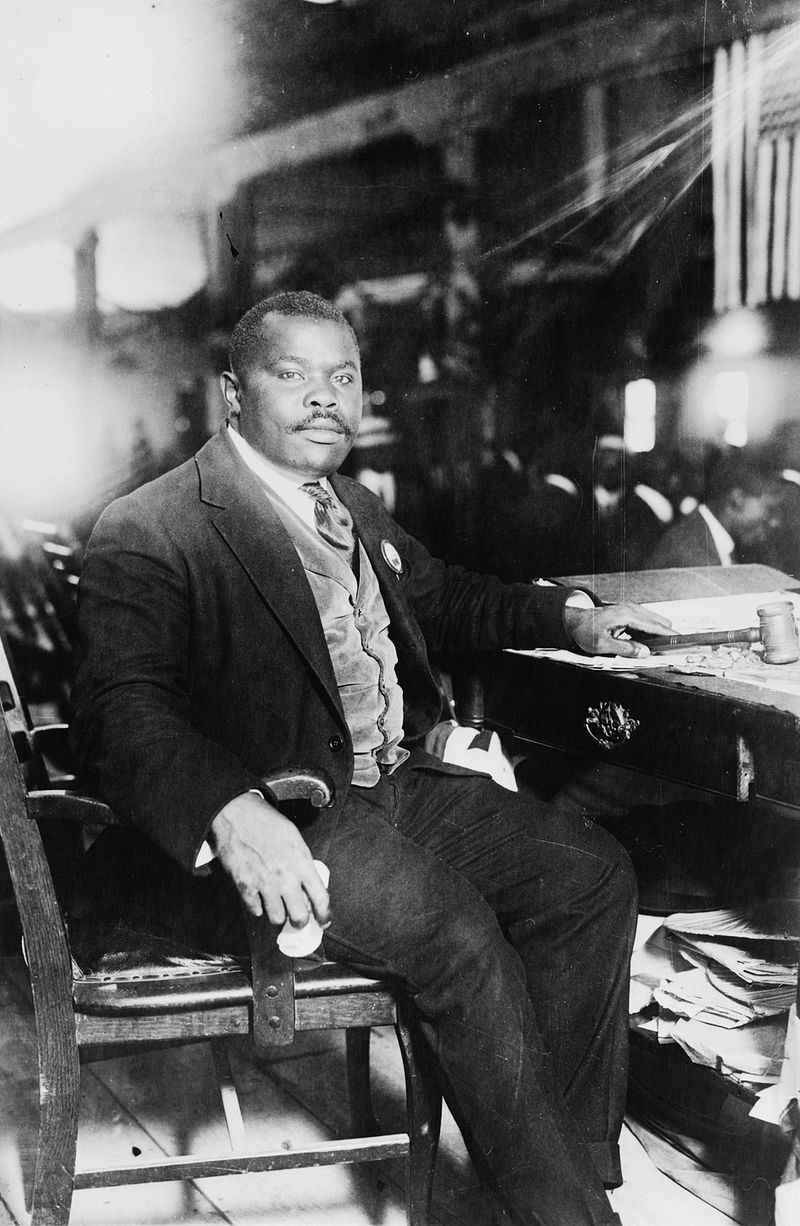
 On August 13, 1920 Marcus Garvey presided at the convention of the United Negro Improvement Association held at Madison Square Garden in New York City. There he promulgated the Declaration of Rights of the Negro Peoples of the World. Its 54 points comprise the farthest thing from a fascist manifesto.
And yet, as my friend Hugh Murray noted a quarter-century ago, Garvey “admired . . . leading anti-communists, such as Mussolini. Indeed, in 1937 Garvey proudly proclaimed of his Universal Negro Improvement Association, ‘We were the first fascists.’[1]
Here’s the full quote:
We were the first Fascists, when we had 100,000 disciplined men, and were training children, Mussolini was still an unknown. Mussolini copied our Fascism.[2]
He said this in 1937, after Mussolini consolidated his rape of Ethiopia.
While many liberals [Murray continues] are the first to hurl the word “fascist” at those with whom they disagree, they usually ignore the fascism of blacks, even when publicly advocated.[3]
A few years after Hugh wrote those words, King’s College Professor of American and English Literature Paul Gilroy came out with “Black Fascism” (Transition, Indiana UPress, 2000, 70-91), a scholarly monograph on Garvey’s boast, the first instance of Black public advocacy of fascism. I recommend it to students of this overlooked chapter of Black American history.

On June 25, 1961 American Nazi Party Commander George Lincoln Rockwell sat in the Uline Arena, Washington, DC (where the Beatles would give their first US concert a few years later). He was there at the invitation of Nation of Islam (NOI) leader Elijah Muhammad. Thousands were in attendance. During the collection, Rockwell shouted:
George Lincoln Rockwell gives $20!
Continue reading ““We were the first fascists”: from Garvey to Farrakhan”


 It was after Sunday Mass at St. Agnes. Finishing breakfast with friends in a 42nd Street a coffee shop, I excused myself to call (using a 20th-century pay phone) my wife who, enduring a cold, couldn’t join me in Manhattan that wintry day.
 By the time my
  I met him for first time at the
  Retiring Representative Luis Gutierrez (D-Ill.) recently
 That is, Ali provides what William Kirkpatrick calls the “smiley-faced version of Islam which emphasizes the commonalities with Catholicism and leaves out the scary parts.” (
 The people turned out to say farewell. Hitler had returned to his Munich regiment, his only foothold, his only home. He was threatened with demobilization and a return to the hostel. A fellow soldier later remembered that Hitler seemed like a stray dog, searching for a new master. In the funeral procession for the Jewish Socialist Eisner was a detachment from Hitler’s regiment wearing both red armbands and black armbands. The film clip shows a lance corporal marching with the officers—Adolf Hitler.