I was taken aback when I first read those words.[1] I reproduced them in my review of Gary Murrell’s biography of Herbert Aptheker: “A biographer must leave out many things, of course, but one wonders why this meeting had to be one of them.”[2]
Aptheker, didn’t take kindly to apostates from Communism, the God who had failed the famous black novelist.
Herbert Aptheker, stateside, 1945-1946
According to Aptheker, however, they agreed to meet in a Manhattan hotel room (almost certainly Wright’s). In fairness to Murrell, upon reflection, I believe Murrell omitted this story because no one else could corroborate it.[3] We have only Stuckey’s citation of Crowder’s interview referenced in a paper by Stuckey that Murrell otherwise drew upon several times.
C. L. R. James in Trafalgar Square, August 1935, protesting the League of Nations’ arms embargo on both the invader (Italy) and the invaded (Ethiopia) (Getty Images)
When did Cyril Lionel Robert James become CLR? From his middle-class youth in colonial Trinidad, he was an omnivorous reader, starting with his mother’s library, drinking in classics from Shakespeare to Thackeray[1], but also history, while developing an intense interest in cricket, which he played and, more successfully, covered in the papers.
In his engrossing C. L. R. James in Imperial Britain, a scholarly study of six years of his subject’s life (1932–1938) between Tunapuna, Trinidad, and New York City, Christian Høgsbjerg notes James’s absorption of the age’s empire-friendly historical narrative. But then he found books that upturned such Received Opinion. Høgsbjerg quotes James from an October 1967 interview wherein James recalls what awakened his capacity for and interest in critical history.
I read an enormous amount of history books . . . chiefly the history of England and later, histories of Europe and ancient civilization. I used to teach history, and reading the lot of them, I gained the habit of critical judgment and discrimination . . . . I remember three or four very important history books. These were a history of England by G. K. Chesterton and some histories of the seventeenth century by Hilaire Belloc. These books violently attacked the traditional English history on which I had been brought up, and they gave me a critical conception of historical writing.[2]
So, James, soon to become a revolutionary Marxist, cited Chesterton and Belloc, orthodox Roman Catholics of the post-Vatican I era, as the fons et origo of his critique of bourgeois historiography![3]
In the early 1930s, under the influence of Trotsky’s A History of the Russian Revolution, James began researching the Haitian revolution. (“At the end of reading the book, Spring 1934, I became a Trotskyist . . .” That is, after his expatriation to the UK, not while in Trinidad. See the October 1967 interview cited in note 2.) Yet as late as August 1933, caught up in the empire’s self-congratulatory celebration of the centennial of the passage of the Slavery Abolition Act,[4] James let these words be published under his name:
Our history begins with it [the Act]. It is the year One of our calendar. Before that we had no history.[5]
He would never make that kind of statement again.
He soon learned, on his own and through the scholarly labors of his former student (and, as future Prime Minister, jailer) Eric Williams (1911-1981), that the slave trade was not abolished because of its iniquity. It was abolished because the planter class had lost economic power. Human conscience just happened to awaken when slavery’s unprofitability became obvious to them.
To be continued.
Notes
[1] “Thackeray, not Marx, bears the heaviest responsibility for me.” C. L. R. James,Beyond a Boundary. Duke University Press, 1993 (1963).
[2] Høgsbjerg, 161, citing Richard Small, “The Training of an Intellectual, the Making of a Marxist,” in C. L. R. James: His Life and Work, ed. Paul Buhle, London: Allison and Busby, 1986, 49-60. This edition’s pagination, which Høgsbjerg used, that of this PDF, wherein Small’s article is on pages 13-18. James was probably referring to Chesterton’s A Short History of England (1917). One cannot know for sure which of Belloc’s books James had in mind, for among them are biographies of Charles I, Charles II, and James II, as well as a life of Cardinal Richelieu. He also wrote The French Revolution (1911), A History of England (1925), and Europe and the Faith (1920), which covers the 17th century’s broader context. Belloc was a splendid stylist.
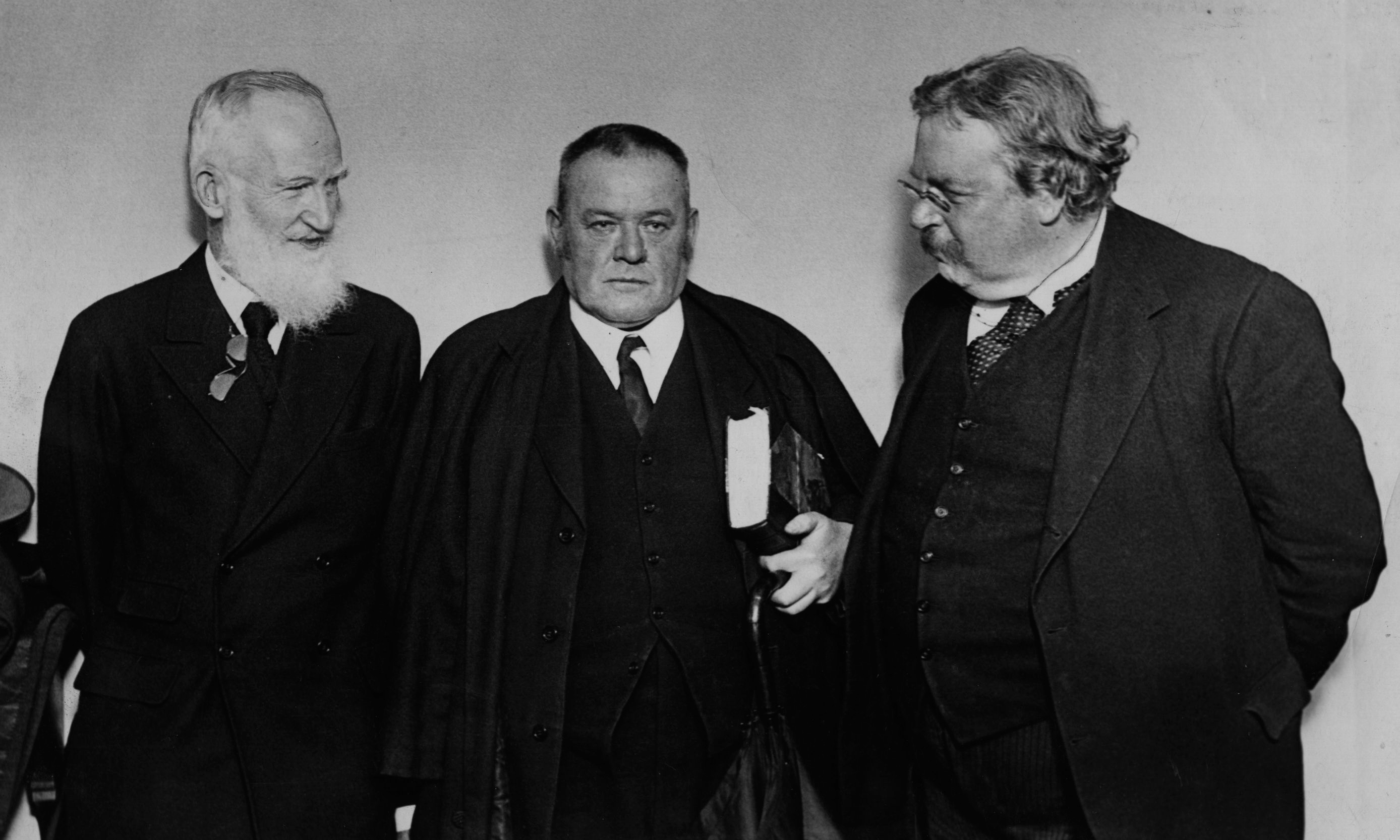
George Bernard Shaw (1856-1950), Hilaire Belloc (1870-1953), Gilbert Keith Chesterton (1874-1936) (1927)
[3] “George Bernard Shaw’s affectionate attack on G.K. Chesterton and Hilaire Belloc, in an article entitled ‘The Chesterbelloc: A Lampoon,’ gave birth to a duomorph destined to find its place in literary legend. Chesterton and Belloc were seen so synonymously, said Shaw, that they formed ‘a very amusing pantomime elephant.’” Joseph Pearce, “The Chesterbelloc: Examining the Beauty of the Beast,”Faith and Reason: The Journal of Christendom College, Spring 2003. Take the link to download the PDF of this article.
[4] What was “abolished,” of course, was Britain’s involvement in the slave trade, on which “good will” the empire traded when they joined Europe’s “scramble for Africa” later in that century.
[5] C.L.R. James, “Slavery Today: Written by the Great-Grandson of a Freed Slave,” Tit-Bits [London], August 1933, 16. Cited in Høgsbjerg, 169. For zoomable, copyrighted image of that page, go here. Incidentally, “Høgsbjerg,” a Danish surname, is pronounced “Huh-s-BYUR” or “Huh-s-BYAHR.”
I missed it by a day (sorry!). The centennial of the birth of Malcolm X and 60 years since his assassination (a few months after his Queens home was firebombed a few miles from me) warrant swiping from my old site two letters that my friend Hugh Murray got published in 1994 and 1995. Without further ado:
What about the Nation of Islam’s Historical Ties to Fascism?
The New York Times, February 23, 1994
It was widely reported when Louis Farrakhan, head of the Nation of Islam, suspended Khalid Abdul Muhammad, who told an audience at Kean College of New Jersey that Jews are bloodsuckers, gays are sissies, and the Pope is a cracker.
Mr. Farrakhan rebuked the manner in which Mr. Muhammad delivered his message, but Mr. Farrakhan reaffirmed the “truths” of that message! Reporters speculate if this is a repudiation of bigotry or not. But they are silent about the history of the Nation of Islam on these subjects.
American Nazi Party Commander George Lincoln Rockwell (center) at a Nation of Islam (NOI) rally, Uline Arena, Washington, DC, June 25, 1961. During the collection, he shouted: “George Lincoln Rockwell gives $20!” (almost $135 in today’s money). Malcolm X, noting the applause, asked him: “George Lincoln Rockwell, you got the biggest hand you ever got, didn’t you?” Elijah Muhammad, NOI founder, invited Rockwell to speak at their next Savior’s Day Convention, which he did on Sunday, February 25, 1962, before 12,175 people in Chicago’s International Amphitheater. (Muhammad Speaks, April 1962, p. 3.) At the podium, in full Nazi regalia, Rockwell opined “that Elijah Muhammad is to the so-called Negro what Adolph Hitler is to the German people. He is the most powerful black man in the country. Heil Hitler!” (Black History and the Class Struggle, Spartacist League, August 1994, p. 37.)
In the early 1960’s, at a large gathering of the Nation of Islam, the featured speaker was Elijah Muhammad, its leader. But the speaker just before him, addressing Elijah Muhammad’s followers, was George Lincoln Rockwell, leader of the American Nazi Party.1
In the early 1960’s Malcolm X, as a Nation of Islam spokesman, mocked the Rev. Dr. Martin Luther King Jr. and the civil rights movement. At the height of civil rights protest Malcolm traveled to the South, not to partake in civil rights protest, but to negotiate with leaders of the Ku Klux Klan on how to thwart the struggle for civil rights. This scene is omitted from Spike Lee’s film and from the recent PBS documentary on Malcolm X.
And in the 1920’s, even before the founding of the Nation of Islam, Marcus Garvey led the Universal Negro Improvement Association, which became America’s largest black nationalist organization. The association created the Black Cross Nurses, the African Legion, the Knights of the Nile and established the Black Star Steamship Line. Though black liberals and socialists like A. Philip Randolph and W. E. B. Du Bois bitterly opposed Garvey, Garvey found other associates—the leaders of the Ku Klux Klan. Continue reading “Marking Malcolm X’s centennial: Hugh Murray’s probing letters from the 1990s.”
The autograph of the 11th Thesis on Feuerbach: “Philosophen haben bisher nur die Welt anders interpretiert; es kommt aber darauf an, sie zu verändern”
Marx and Engels’s oft-cited 11th Thesis on Feuerbach, penned in 1844 but not published until 1888, is perhaps the closest thing we have to words that function as holy scripture for communists: “Philosophers have only interpreted the world, in various ways; the point, however, is to change it.”[1] Changing the world is allegedly what “matters,” but it’s dogmatically assumed, never argued for. It’s as de fide, as much a matter of faith, as, for example, the Immaculate Conception is for Catholics, and just as ungrounded in Scripture.
The aim of this series is to expose Marxism as an instance of the “foolishness of the wisdom of this world” (1 Corinthians 1:20) from the Bible’s standpoint. No Marxist as such has warrant for pontificating that “the point” is to change the world. The point of what? What can be “the point” in an ultimately pointless world, as distinct from the world in which God works all things according to the counsel of His will (Ephesians 1:11)?
My focal points, as you know by now, are C. L. R. James, Richard Wright, and Herbert Aptheker, men who understandably (only because they lived in God’s world and were created in His image) raged against the indignities of racial subjugation, colonialism, and imperialism that they experienced, witnessed, or studied. (That’s an inclusive “or,” by the way.) For several decades of their lives, they believed that they found in Marxism the conceptual tools they needed for addressing those evils.
Their biographies make for stimulating reading, but how does Marxist revolution answer the moral outrage of interracial subjugation, cruelty, and savagery, especially since we know that it has only added to the history of moral outrage? How can Marxist theory articulate any ethical complaint without borrowing from the Christian worldview they thought was beneath their notice? Continue reading “The “point” of what, exactly? What “matters”? The groundless ethical imperative of Marxist revolutionaries.”
This, to me, was a spectacle of glory; and yet, because it had condemned me, because it was blind and ignorant, I felt that it was a spectacle of horror. The blindness of their [Communists’] limited lives—lives truncated and impoverished by the oppression they had suffered long before they had ever heard of Communism—made them think that I was with their enemies. American life had so corrupted their consciousness that they were unable to recognize their friends when they saw them. I knew that if they had held state power, I should have been declared guilty of treason and my execution would have followed.—Richard Wright, 1944[1]
Forty-seven years later, another Stalinist uttered those three words:
Had that leadership [of the Communist Party] held state power, past history suggests that those signers [of “An Initiative to Unite and Renew the Party”] would now be dead.—Herbert Aptheker, 1991[2]
About a year after Wright arrived in New York, an anti-Stalinist revolutionary was also New York-bound from England, but a Stalinist graciously but firmly warned him:
There was a black man who had joined the CP [Communist Party of Great Britain]. He said to me that you could do that in Britain and keep breaking up their meetings, but in America, if you carry on like that, they will kill you. As far as the police were concerned, if a Stalinist killed a Trotskyist, they would have no part of that, so just take it easy. The difference between British democracy and democracy in the United States is that there you have to be aware, not of the government, but of the Stalinists.—C. L. R. James, circa 1938.[3]
In 1978, on the corner of Wall and Broad Streets in Manhattan’s financial district, where I would listen to Gabe Monheim expound the Scriptures and soon come to Christ, an older Stalinist I had known a few years earlier—his face contorted in hatred and words dripping in bile—volubly branded me a “counterrevolutionary traitor.” I have no doubt that had “tough Tony from Da Bronx” taken the bait, he would have met the fate that James’s Stalinist acquaintance predicted.
Notes
[1] Richard Wright, “I Tried to Be a Communist,”The Atlantic Monthly, September 1944, 54; italics mine. This was the second part of a two-part series that became a chapter of The God That Failed, Richard Crossman, ed., Columbia University Press, 2001; originally, The God That Failed: A Confession, Harper & Brothers, 1949.
[3]Interview of C. L. R. James by Al Richardson, Clarence Chrysostom, and Anna Grimshaw in South London, June 8 and November 16, 1986; italics mine.
Three years before that interview, that is, in 1983, James received an honorary degree from Hull University. At the podium is Baron Wilberforce, a great-great-grandson of abolitionist William Wilberforce. For the background, go to https://www.africansinyorkshireproject.com/clr-james.html
That’s the question underlying my current project. Answering it might explain why I was drawn to revolutionary Marxism (of interest at least to me, if not to you). Youngsters can be at once hypercritical and credulous. Revolutionary rejecters of the existing order, they fall for one or another “explanation” hook, line, and sinker.
Rummaging through the lives of Marxist intellectuals is no mere romantic, antiquarian interest of mine (although it is partly that). I will draw upon but not add to the biographies already written. I’m trying to understand, to the extent it is intelligible, the demonic madness we see on college campuses, draped in the language of moral outrage. (“F— finals! Free Palestine!,” announced one savage disrupting Columbia University students who were trying to use the main library to prepare for final exams, to cite only one example. I find the categories of intelligibility in Christian theology, specifically anthropology.
Created in God’s image and living in His world as (we all are), the miscreants have a sense of moral outrage (however misinformed), but they have nothing in which to ground it. On Monday, they’ll affirm that it’s wrong to starve children; on Tuesday, that an unborn child’s natural protector has the right to procure the services of an abortionist to destroy that child chemically, or cut him or her to pieces, or leave him or her to expire on a metal table. Most of them, if pressed, will say that, strictly speaking, we don’t know that we have more moral dignity than that of “evolved,” i.e., rearranged, pond scum. They merely dogmatize that we do.
I’m stepping back from the news and noise of the day to reflect on more civilized specimens of humanity, however much their careers betrayed the civilizing impulse. I want to explore why they thought Marxist revolution adequately addressed the moral outrage of interracial subjugation, cruelty, and savagery, evils that energized them? That it was such an answer is the conclusion at which my three very different intellectuals arrived. It all starts with outrage at one or another fact in one man’s experience: colonialism, imperialism, slavery, peonage, Jim Crow.
Richard Wright (1908-1960), Lido, Venice, 1950. (Archivio Cameraphoto Epoche/Getty Images)
The subject line is the working title of a projected study of three fascinating writers and their interactions. I will undertake this as an exercise not only in historical exposition but also in Christian apologetics.
That is, as an epistemologically self-conscious Christian individualist living in the dispensation of the grace of God in anticipation of His inauguration of the Manifest Kingdom of God, I will explore the intellectual and personal trajectories of three radical intellectuals—Herbert Aptheker (1915–2003), C. L. R. James (1901–1989), and Richard Wright (1908–1960)—whose materialist epistemologies rendered their political projects not only impossible of realization, but also absurd. Christians can nevertheless learn from them, if only indirectly.
W. E. B. Du Bois (1868-1963) “The problem of the twentieth century is the problem of the color-line.” The Souls of Black Folk (1903)
United by secularism and engagement with black history, they were collectivists philosophically, but individualists in how they lived their lives. But their individualism was not enough to save them. They all failed to discern the true dividing line of their times and ours: not the “color line” that W. E. B. Du Bois (1868-1963) predicted would define the 20th century, but rather the line in the sand drawn by the God-breathed Scriptures (Matthew 4:4).
Their rejection of the latter marks a common, tragic undercurrent. I will examine their shared but divergent paths, focusing on their anti-Christian secularism, Marxist commitments (Stalinism, Trotskyism, non-Communist revolutionary thought), and struggles with racism, ironically and tragically, they could not interpret soundly, let alone condemn, apart from the worldview they rejected. Their second-rate epigones among our contemporaries are no less intellectually bankrupt, but their frank embrace of the horrors to which their plans lead enhances the relevance of this study, which is of more than antiquarian interest.
“Saint Dismas the Good Thief.” Icônes arabes : art chrétien du Levant, France: Institut du monde arabe (Public domain)
One of the criminals alongside whom Jesus was crucified said that while He had done nothing to deserve capital punishment, they had. That malefactor said they had received it justly (δικαίως, dikaiōs) and prayed He would remember him when He comes into His kingdom, implying that He is a King.
Jesus then spent what little energy He had left to promise the penitent one life in that Kingdom—but not to correct his penology (Luke 23:39-43). He had no reason to. As God (אֱלֹהִ֔ים, Elohim) warned Noah, “Whoever sheds the blood of man, by man shall his blood be shed, for God made man in his own image” (Genesis 9:6).
This imperative is honored in many places in the Law of Moses, which He came to fulfill. “Do not think that I have come to abolish the Law or the Prophets; I have not come to abolish (καταλῦσαι, katalysai) them but to fulfill them” (Matthew 5:17). His dying, however, would abolish (καταργήσαντος, katargēsantos) death itself (2 Timothy 1:10).
This week especially, those of us who by His grace identify with the penitent malefactor embrace that truth.
This review of James Heartfield, Unpatriotic History of the Second World War, London, Zer0 Books, 2012, a socialist’s deep dive into the real history of the Second World War appeared on Amazon today.—A.G.F
As an editor and bibliophile, I agree with the many critics of this book’s infelicities (typos, organizational issues, lack of index, and so forth). Nevertheless, I thank God James Heartfield wrote it, that he spilled his cornucopia of insights out of his head and onto paper. Let some publisher step forward to polish its contents so it passes conventional muster. Until then, however, students of this endlessly fascinating subject should benefit from the author’s vast knowledge of how things hung together eighty and ninety years ago—I say this even though the underlying worldview is not mine.
At odd moments, I’d pull out my phone on which this book’s Kindle version resides and say, “Okay, I have ten minutes.” An hour later, I’d see that I couldn’t stick to that budget but had continued swiping left, page after page.
The author of other meaty historical tomes (for example, Britain’s Empires: A History, 1600–2020, 2022; The Blood-Stained Poppy: A critique of the politics of commemoration, 2019; and The British and Foreign Anti-Slavery Society, 2016—to cite a few), Heartfield gives off no whiff of the Olympian stuffiness of many academics, as we expect of the lecturer we find on YouTube. I recommend watching his 2016 talk on C.L.R. James and the Left’s opposition to taking sides in the Second World War and the ethical issues that opposition posed. Heartfield’s reference (on page 151) to James’s 1940 penny-pamphlet “My Friends” A Fireside Chat on the War—written under the pseudonym “Native Son” (which momentarily confused me, since in 1940 Native Son’s author, Richard Wright, was still a “The Yanks Aren’t Coming” Stalinist)—led me happily to the tattered copy available on archive.org.
United Auto Workers strikers and picketers demonstrate in front of the Ford plant in Windsor, Ontario, 1945. (AFP via Getty Images)
Capitalist pig that I am, I found myself delightfully caught up in Heartfield’s retailing of the dialectic of industrial and military labor: the strike threat versus the Nazi threat—even if opportunities to avoid global conflagration were missed. Brits at the battlefront, Heartfield notes, well understood why those on the home front might withhold their labor from their industrial employers to wrangle out of them more favorable terms. (I’m just not crazy about commandeering the property of others to prevent equally hungry workers from taking the strikers’ place. Nor about the dehumanization of the would-be replacements as “scabs,” but we can’t debate that here.)
I was trained in philosophy, but it has been the historians I’ve known, not the philosophers, who have struck me as “omniscient.” (I first got this impression when working for—don’t laugh—Herbert Aptheker. Feel free to search <Anthony Flood C. L. R. James Herbert Aptheker>.) Historians can talk seemingly non-stop about events from centuries ago as if they were current. And that’s how Heartfield’s grasp of his material strikes me.
I’m not used to socialists making me review my grasp of history, but always happy to praise those who do that. Heartfield is one of them.
On the tenth anniversary of my old (but extant) site anthonyflood.com (NB: no middle initial), I celebrated the publication of my Aptheker-James article in the C. L. R. James Journal. (It forms chapter 2 of my 2019 book, Herbert Aptheker: Studies in Willful Blindness, a second, expanded edition of which I’m trying to finance.) Those familiar with this story may skip this “old news,” although I believe its historical “feel” sets it apart from accounts posted elsewhere on this site, as does my digression into metaphilosophy. (A search for <James Aptheker> will return all of them.) There are, of course, always those who are hearing about this for the first time. I’d be happy to hear from either class of visitors.
Marking a Decade (January 17, 2014)
On the occasion of the tenth anniversary of this site, I am pleased to report the publication of my article “C. L. R. James: Herbert Aptheker’s Invisible Man,” in the Fall 2013 issue of the CLR James Journal. It arrived in the mail two days ago, and I purchased access to the online version of my essay this morning (sort of an anniversary present to myself). Hazily aware for four decades of C. L. R. James (1901-1989), author of The Black Jacobins: Toussaint L’Ouverture and the San Domingo Revolution, the umpteenth sighting of his name in my reading material (this time it was in a piece by Dwight Macdonald) over the course of a few months in 2012 triggered an odd reverie and query. (In the late thirties and early forties Macdonald and James’s circles partly overlapped.)
Herbert Aptheker (1915-2003), once one of the leading intellectuals in the Communist Party of the United States of America (CPUSA), was a ground-breaking Marxist historian of American slave revolts. So why hadn’t James’s work figured into his writings (virtually all of which I had read before I was twenty)? Why hadn’t James’s name ever crossed Aptheker’s lips during our many conversations about the early years while I served as one of his research assistants in the early seventies? After some research, I concluded that Aptheker’s neglect of James was deliberate. Continue reading “When Aptheker dissed James, revisited. (No April Fool’s joke.)”


 I missed it by a day (sorry!). The centennial of the birth of

 [1]
[1] Dangerous Communist in the United States”: A Biography of Herbert Aptheker


 As an editor and bibliophile, I agree with the many critics of this book’s infelicities (typos, organizational issues, lack of index, and so forth). Nevertheless, I thank God James Heartfield wrote it, that he spilled his cornucopia of insights out of his head and onto paper. Let some publisher step forward to polish its contents so it passes conventional muster. Until then, however, students of this endlessly fascinating subject should benefit from the author’s vast knowledge of how things hung together eighty and ninety years ago—I say this even though the underlying worldview is not mine.
  History, 1600–2020, 2022; The Blood-Stained Poppy: A critique of the politics of commemoration, 2019; and The British and Foreign Anti-Slavery Society, 2016—to cite a few), Heartfield gives off no whiff of the Olympian stuffiness of many academics, as we expect of the lecturer we find on YouTube. I recommend watching his 2016 talk on C.L.R. James and the Left’s opposition to taking sides in the Second World War and the ethical issues that opposition posed. Heartfield’s reference (on page 151) to James’s 1940 penny-pamphlet “My Friends” A Fireside Chat on the War—written under the pseudonym “Native Son” (which momentarily confused me, since in 1940 Native Son’s author, Richard Wright, was still a “The Yanks Aren’t Coming” Stalinist)—led me happily to the tattered copy available on archive.org.
 On the tenth anniversary of my old (but extant) site
  On the occasion of the tenth anniversary of this site, I am pleased to report the publication of my article “C. L. R. James: Herbert Aptheker’s Invisible Man,” in the Fall 2013 issue of the CLR James Journal. It arrived in the mail two days ago, and I purchased access to the online version of my essay this morning (sort of an anniversary present to myself). Hazily aware for four decades of C. L. R. James (1901-1989), author of The Black Jacobins: Toussaint L’Ouverture and the San Domingo Revolution, the umpteenth sighting of his name in my reading material (this time it was in a piece by Dwight Macdonald) over the course of a few months in 2012 triggered an odd reverie and query. (In the late thirties and early forties Macdonald and James’s circles partly overlapped.)
 Herbert Aptheker (1915-2003), once one of the leading intellectuals in the Communist Party of the United States of America (CPUSA), was a ground-breaking Marxist historian of American slave revolts. So why hadn’t James’s work figured into his writings (virtually all of which I had read before I was twenty)? Why hadn’t James’s name ever crossed Aptheker’s lips during our many conversations about the early years while I served as