Emil Brunner was no Christian Individualist, but he had Rome’s number, and Otis Q. Sellers took careful note

Emil Brunner (1889-1966)

[Also on Substack]

And Otis Q. Sellers was no Neo-Orthodox. Yet, as I noted in a previous article, he found 1953 The Misunderstanding of the Church by Emil Brunner (1889-1966) valuable for contextualizing his own ecclesiology. So do I.

Brunner was clear about Rome’s conceit concerning its authority: she must ever try to discredit Sola Scriptura, the Reformation principle that affirms the Bible’s final authority, an effort that has effectively meant replacing it with Sola Ecclesia, Rome’s putative “magisterium.”

The following are salient paragraphs from Chapter 4 of Brunner’s The Misunderstanding of the Church (trans. Harold Knight, The Westminster Press, 1953, 41-45). I’ve broken up paragraphs for ease of reading and copy-edited them lightly. Annotations are in square brackets.

“Oh,” today’s Catholic might protest, “we don’t believe that anymore!” Really? Then what would be left of Rome’s much vaunted theological unity, her alternative to Protestant “anarchy”?

Who believes that the Jesuits of the 16th century would not have every LGBTQ-friendly Jesuit of the 21st, along with their Vatican allies, burnt at the stake?

Who believes that Leo XIII (r. 1878 to 1903) would not have excommunicated Leo XIV?

I expound the scriptural basis of Sellers’s dispensationalist ecclesiology—non-Darby/Scofield, I hasten to add!—in Christian Individualism: The Maverick Biblical Workmanship of Otis Q. Sellers, which I expect to be published mid-year (God willing) by Atmosphere Press. It’s in the interior design phase. Continue reading “Emil Brunner was no Christian Individualist, but he had Rome’s number, and Otis Q. Sellers took careful note”
The Centenary of Murray N. Rothbard

Hoping Stephan Kinsella or Hans-Hermann Hoppe won’t sue me for copyright violation, I can think of no better way for this site to memorialize this milestone than to reproduce this cornucopia of resources from The Property and Freedom Society, whose site I could not safely open. Since maybe you can’t either, I’m grateful to internet argonaut Dave Lull for copying and pasting its table of contents into an email. (Two humble contributions of mine made the list!)

Murray was a lad of 58, I a mere babe in the libertarian woods (only 29), when I first met him. What a powerful, creatively synthesizing mind; what a generous friend! May God grant him eternal life in the Kingdom!

Anthony Flood

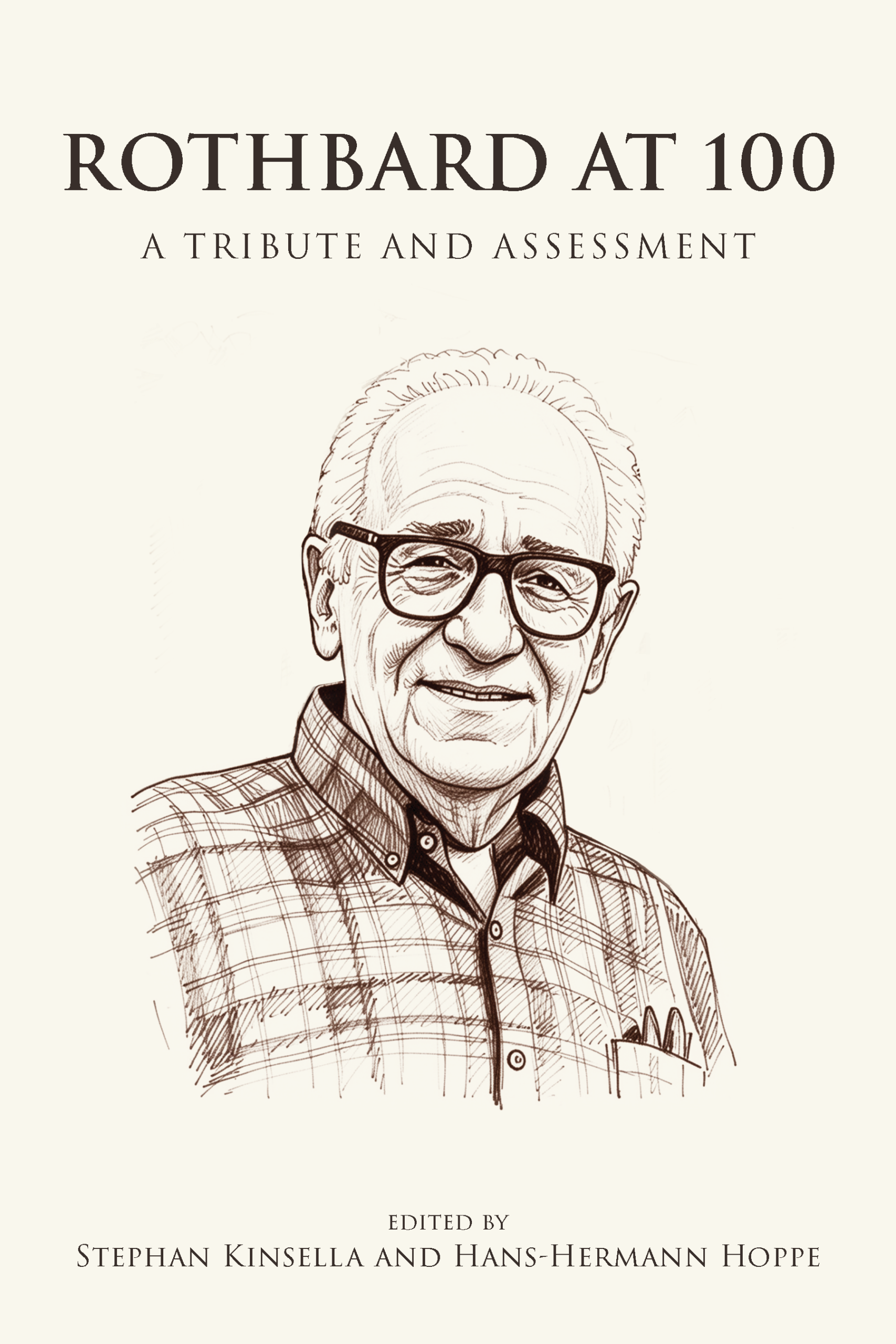
Rothbard at 100: A Tribute and Assessment

by Stephan Kinsella on January 9, 2026

– Other PFS books –

Rothbard at 100: A Tribute and Assessment, Stephan Kinsella and Hans-Hermann Hoppe, eds. (Papinian Press and The Saif House, 2026).

Murray N. Rothbard (1926–1995) was one of the world’s greatest champions of the human liberty. In his honor, and to commemorate his 100th birthday, on March 2, 2026, the Property and Freedom Society (PFS) has assembled this collection of tributes to and commentary on him and his work by PFS members, including many who knew him personally.

This book is released in digital form today, March 2, 2026, on Murray’s 100th birthday. Print, in both paperback and deluxe hardcover, and kindle/epub/pdf versions will be made available shortly.

[Note: the links below will go live March 2, 2026, at 12:01am CST, as will this announcement: Rothbard at 100: A Tribute and Assessment Published Today]

Contents

Front Matter

Part 1*

Part 2

Appendix

*Part 1 consists of PFS authors who personally knew or met Rothbard

Related

Biographical

Bibliographical

Correspondence

Tributes/obituaries/memories/commentary

Notes

    1. See The Free Market (June 1986), p. 2, listing papers in “Man, Economy, and Liberty: A Conference in Honor of Murray N. Rothbard.” See also: Jeffrey Tucker and Lew Rockwell, “Man, Economy, and Liberty” (17 November 2009) (Tucker interviews Rockwell about Rothbard’s festschrift, published in 1986 in honor of Rothbard’s sixtieth birthday); Rothbard, Man, Economy, and Liberty (1 March 1986) (Rothbard comments and responds to the speakers and papers presented at the “Man, Economy and Liberty” colloquium hosted by the Mises Institute; backup Youtube); Hoppe, Book Review of Walter Block and Llewellyn H.Rockwell, Jr., eds., Man, Economy, and Liberty: Essays in Honor of Murray N. RothbardRev. Austrian Econ. (Vol. 4 Num. 1, 1989). See also Timothy Virkkala, “Bestschrift,” Liberty (September, 1989), p. 63.
    2. “I prefer to remember him as the charming, brilliant, and joyous friend he had been in Liberty‘s formative years. He was the wittiest man I have ever met, the best man with whom to spend an evening in a bar that I ever knew. I miss him enormously.”
    3. excerpted here: “Shortly before Murray [Rothbard] died, I called him to tell him of my plans to run for Congress once again in the 1996 election. He was extremely excited and very encouraging. One thing I am certain of—if Murray could have been with us during the presidential primary in 2008, he would have had a lot to say about it and fun saying it. He would have been very excited. His natural tendency to be optimistic would have been enhanced. He would have loved every minute of it. He would have pushed the “revolution,” especially since he contributed so much to preparing for it. I can just imagine how enthralled he would have been to see college kids burning Federal Reserve notes. He would have led the chant we heard at so many rallies: “End the Fed! End the Fed!”
    4. Duke is former counsel to the Mises Institute. “Murray N. Rothbard is the most intelligent and informed man I have met in my entire life! He like Ludwig von Mises, refused to speak and write only the truth. This hurt Mises and Rothbard financially their entire lives. They were ridiculed by the mainstream economists, government, new media, academics. But they held to the truth that they knew in their minds and hearts. I knew Murray N. Rothbard personally and he was kind to everyone. He was so brilliant that most people were nervous when they met him. Murray usually told a joke or said something weird, strange, funny or whatever to make people comfortable. He did not laugh; he cackled. He was jovial. I had lunches and dinners with him and spoke with him at the Mises institute. I was the attorney for the Mises Institute in the early years. – JRD”